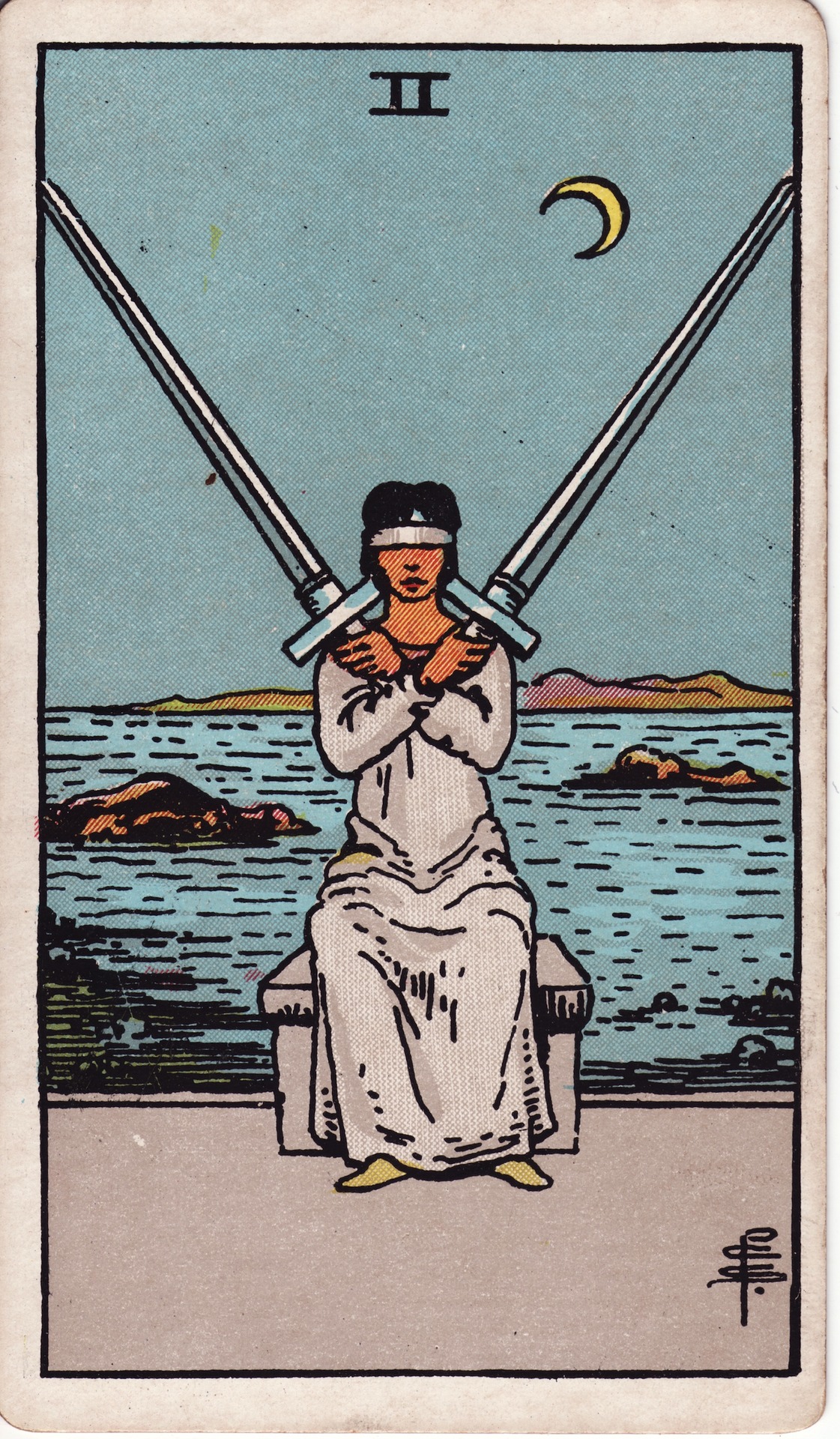
Two of Swords
The Two of Swords represents mental equilibrium, suspension, and the deliberate holding of opposites in balance. In the Rider–Waite deck, a blindfolded figure sits before calm waters, holding two crossed swords. Where the Ace of Swords introduces pure clarity and truth, the Two of Swords depicts the moment when that clarity meets contradiction. Action pauses; not from weakness, but from necessity.
This card reflects a state of mental stillness created by unresolved polarity. Awareness is present, but decision is withheld. Peace exists, though it is fragile and temporary.
Esoteric Meaning
In practical interpretation, the Two of Swords signifies:
- Mental balance and stalemate
- Suspension of judgment
- Avoidance or delay of decision
- Emotional detachment
- Controlled neutrality
At a deeper level, the Two of Swords represents peace achieved through containment. Conflicting thoughts or truths are held in equal tension, preventing escalation but also preventing resolution. The card teaches that balance can be a strategy—but not a permanent solution.
In its shadow aspect, the Two of Swords can indicate denial, repression, or fear of confronting truth. When balance is used to avoid insight, stagnation replaces peace.
The Two of Swords on the Tree of Life
In the Golden Dawn system, the Two of Swords is attributed to Chokmah in Yetzirah.
Chokmah represents dynamic force and polarity. When expressed through Air, it produces mental tension held in equilibrium. The peace here is not resolution, but the absence of immediate conflict; a pause between opposing currents of thought.
This is the intellect recognizing duality but not yet choosing integration.
Symbolism in the Rider–Waite Deck
Each symbol reinforces suspended judgment:
- The Crossed Swords: Equal and opposing ideas
- The Blindfold: Refusal or inability to see clearly
- The Calm Sea: Emotional stillness beneath tension
- The Seated Figure: Inaction by choice
- The Moon: Subconscious influence on perception
The Two of Swords teaches that peace maintained through avoidance is temporary.
Role in the Great Work
Within the Great Work, the Two of Swords represents the first test of discernment. After awakening of clarity, the practitioner encounters contradiction. Truth is no longer singular; it must be weighed, compared, and ultimately chosen.
This card teaches that equilibrium is valuable, but growth requires eventual movement. Holding tension indefinitely delays transformation.
Where the Ace of Swords cuts through illusion, the Two of Swords pauses before decision.
FAQ 1: What does the Two of Swords represent in the Golden Dawn tradition?
In the Golden Dawn, the Two of Swords represents the first polarization of Air; the emergence of duality within the intellect. It governs equilibrium, mental tension, and the holding of opposing ideas in conscious balance.
FAQ 2: Is the Two of Swords about indecision or avoidance?
Not primarily. While it may appear as stillness, the Two of Swords is not avoidance. In Golden Dawn teaching, it represents active mental balance; the deliberate suspension of judgment to maintain clarity before decisive action.
FAQ 3: How is the Two of Swords related to the Tree of Life?
The Two of Swords corresponds to Chokmah in the world of Yetzirah. This placement represents dynamic force operating within the mental realm, where polarity emerges but has not yet fractured into conflict.
FAQ 4: What elemental force governs the Two of Swords?
The Two of Swords is governed by the element of Air. Air here is expressed as equilibrium of thought, intellectual poise, and the capacity to hold tension without collapse into confusion or dogma.
FAQ 5: How does the Two of Swords function initiatorily?
Initiatorily, the Two of Swords teaches restraint of the intellect. The initiate learns that clarity sometimes requires non-action, allowing truth to reveal itself through balance rather than impulsive decision-making.
FAQ 6: What happens when the Two of Swords is unbalanced or misunderstood?
When unbalanced, the Two of Swords may manifest as paralysis, denial, or emotional suppression. In Golden Dawn doctrine, imbalance occurs when equilibrium becomes stagnation and discernment is avoided rather than refined.