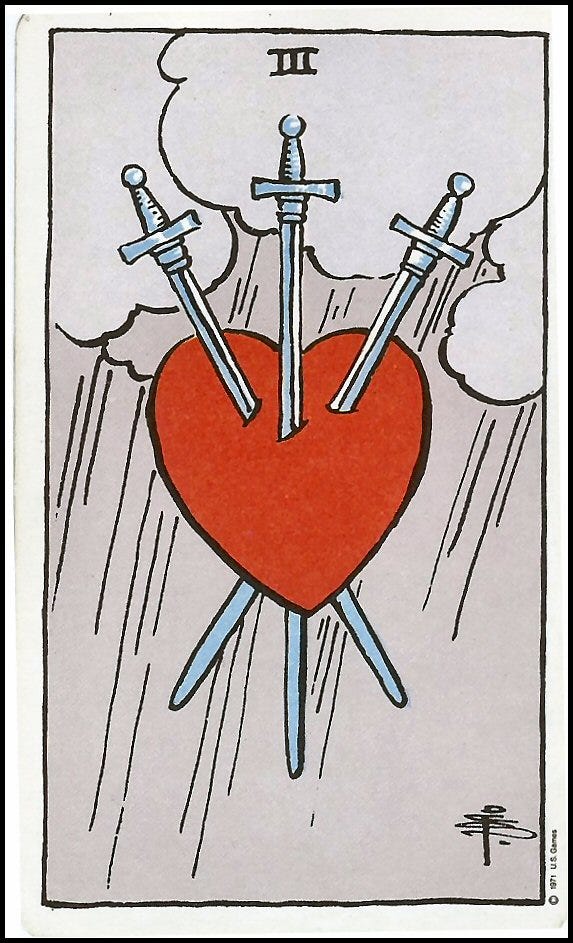
Three of Swords
The Three of Swords represents rupture, painful truth, and the consequences of mental division. In the Rider–Waite deck, three swords pierce a heart beneath a storm-filled sky. Where the Two of Swords maintains uneasy balance through suppression, the Three of Swords depicts what occurs when that tension breaks open. Truth is no longer contained; it wounds.
This card marks the moment when clarity becomes emotionally costly. Illusion has ended, but the price of insight is felt deeply.
Esoteric Meaning
In practical interpretation, the Three of Swords signifies:
- Heartbreak and sorrow
- Painful realizations
- Separation and loss
- Conflict between thought and feeling
- Truth that cannot be avoided
At a deeper level, the Three of Swords represents knowledge gained through suffering. It teaches that the intellect, when divorced from compassion, can cut deeply; yet without this cut, falsehood persists. Pain here is not meaningless; it is corrective.
In its shadow aspect, the Three of Swords can indicate bitterness, fixation on pain, or intellectual cruelty. When sorrow is clung to rather than processed, it hardens into resentment.
The Three of Swords on the Tree of Life
In the Golden Dawn system, the Three of Swords is attributed to Binah in Yetzirah.
Binah represents understanding, structure, and limitation. When expressed through Air, it produces comprehension gained through loss. The Three of Swords reflects the sorrow inherent in understanding reality as it is rather than as it was hoped to be.
This is the pain of awareness maturing.
Symbolism in the Rider–Waite Deck
Each symbol reinforces emotional rupture caused by truth:
- The Pierced Heart: Emotional vulnerability exposed by thought
- The Three Swords: Repeated or layered mental injury
- The Storm Clouds: Turmoil and grief
- The Rain: Release through sorrow
- The Stark Composition: No distraction from pain
The Three of Swords teaches that clarity without integration hurts.
Role in the Great Work
Within the Great Work, the Three of Swords represents the necessary suffering of awakening intellect. After neutrality collapses, the practitioner must endure the emotional consequences of truth. This is where discernment begins to mature beyond abstraction.
The card teaches that sorrow, when faced honestly, refines perception and deepens compassion. Pain becomes a teacher rather than an endpoint.
Where the Two of Swords avoids decision, the Three of Swords forces recognition.
FAQ 1: What does the Three of Swords represent in the Golden Dawn tradition?
In the Golden Dawn, the Three of Swords represents the structuring of Air—the moment when intellect crystallizes into distinction, separation, and clear definition. It governs truth revealed through division rather than harmony.
FAQ 2: Is the Three of Swords only about heartbreak or emotional pain?
No. While emotional pain may be experienced, the Three of Swords is not fundamentally about heartbreak. In Golden Dawn teaching, it represents the pain of clarity, where illusion is cut away and truth is known without comfort.
FAQ 3: How is the Three of Swords related to the Tree of Life?
The Three of Swords corresponds to Binah in the world of Yetzirah. Binah brings structure and understanding; in Yetzirah, this manifests as mental separation, discernment, and the formation of boundaries through thought.
FAQ 4: What elemental force governs the Three of Swords?
The Three of Swords is governed by the element of Air. Here, Air expresses itself as analysis, division, and the capacity to distinguish truth from falsehood—even when that distinction is painful.
FAQ 5: How does the Three of Swords function initiatorily?
Initiatorily, the Three of Swords teaches that growth requires honesty. The initiate must accept separation, disappointment, or loss of illusion in order to gain genuine understanding and intellectual integrity.
FAQ 6: What happens when the Three of Swords is unbalanced or misunderstood?
When unbalanced, the Three of Swords may manifest as cruelty, cynicism, or excessive criticism. In Golden Dawn doctrine, imbalance occurs when clarity is weaponized rather than used in service of truth.