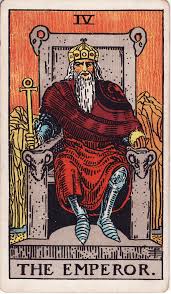
The Emperor
The Emperor represents structure, authority, and the establishment of order. In the Rider–Waite deck, he sits upon a stone throne adorned with ram heads, symbols of strength and initiative, holding the ankh and scepter of dominion. Where the Empress embodies generative abundance, the Emperor provides form, boundary, and law. He is the principle that stabilizes creation and ensures its continuity.
Numbered IV, the Emperor signifies solidity, foundation, and control. He is the architect of systems, the force that organizes growth into enduring structure. Through the Emperor, creative potential becomes governed reality, capable of persistence rather than chaos.
Esoteric Meaning
In practical interpretation, The Emperor signifies:
- Authority and leadership
- Structure and discipline
- Stability and protection
- Responsibility and governance
- Rational control
At a deeper level, the Emperor represents conscious order imposed with wisdom. He teaches that freedom requires structure and that true authority arises not from domination, but from responsibility. The Emperor is mastery over the material world through clarity, discipline, and law.
In his shadow aspect, the Emperor can indicate rigidity, authoritarianism, or control driven by fear. When structure becomes inflexible, it stifles the very life it is meant to support.
The Emperor on the Tree of Life
In the Golden Dawn system, The Emperor corresponds to the Hebrew letter Heh (ה) and is assigned to Path 15 on the Tree of Life.
- Path: 15
- Connects: Chokmah (Wisdom) → Tiphareth (Beauty)
- Hebrew Letter: Heh
- Astrological Attribution: Aries
This path represents the assertion of divine force into balanced expression. Chokmah provides raw, expansive energy; Tiphareth represents harmony and centered self-awareness. The Emperor channels creative impulse into decisive action, establishing identity, direction, and authority.
Aries governs initiative, leadership, and the courage to act, qualities essential to the Emperor’s role as stabilizer and protector of the created order.
Symbolism in the Rider–Waite Deck
Every element reinforces the Emperor’s function:
- The Stone Throne: Permanence and unyielding structure
- The Ram Motifs: Initiative, strength, and assertive force
- The Ankh: Life governed by conscious authority
- The Barren Mountains: Mastery over harsh conditions
- The Red Robes: Vitality disciplined by will
The Emperor rules not through force alone, but through established law and clarity of command.
Role in the Great Work
Within the Great Work, the Emperor represents the stage of consolidation. After creation and growth, the work must now be stabilized, defended, and governed. This is the moment where insight and creativity are bound into systems capable of enduring pressure and time.
The Emperor teaches responsibility for one’s creation and the necessity of boundaries. Without structure, the Great Work dissipates; without discipline, it cannot mature.
Where the Empress brings life into the world, the Emperor ensures it stands.
FAQ 1: What does The Emperor represent in the Golden Dawn tradition?
In the Golden Dawn, The Emperor represents authority, law, and structural order. He governs the principle that organizes creative force into stable systems, ensuring that what has been generated can endure, function, and be governed intelligently.
FAQ 2: Is The Emperor a symbol of domination or control in Golden Dawn teaching?
No. The Emperor is not tyranny or ego-driven control. In Golden Dawn doctrine, he represents lawful authority—the capacity to establish boundaries, responsibility, and order in alignment with higher purpose rather than personal power.
FAQ 3: How is The Emperor associated with the Tree of Life?
The Emperor corresponds to the path connecting Chokmah (Wisdom) to Tiphareth (Beauty). This path represents the descent of governing intelligence into the center of consciousness, where authority becomes balanced, ethical, and purposeful.
FAQ 4: What planetary or elemental force is associated with The Emperor?
In the Golden Dawn system, The Emperor is associated with Aries and ruled by Mars. This reflects the disciplined application of force; action guided by law, courage tempered by responsibility, and power exercised with restraint.
FAQ 5: How does The Emperor function initiatorily?
Initiatorily, The Emperor follows the generative power of The Empress by imposing structure. He tests whether creation can be governed without rigidity and whether authority can be exercised without corruption or excess.
FAQ 6: What happens when The Emperor is unbalanced or distorted?
When unbalanced, The Emperor may manifest as authoritarianism, rigidity, or domination. In Golden Dawn teaching, this occurs when structure is severed from wisdom. Properly integrated, The Emperor provides stability, protection, and ethical leadership.
FAQ 7: Why is The Emperor essential to the Great Work?
The Emperor is essential because the Great Work requires order and responsibility. Without structure, creative force dissipates. The Emperor ensures that spiritual insight is embodied through discipline, governance, and coherent action in the world.