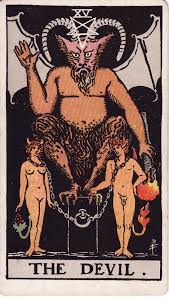
The Devil
The Devil represents bondage, illusion, and attachment to the material and instinctual world. In the Rider–Waite deck, a horned figure presides over two chained human forms, who appear bound yet not truly restrained. Where Temperance restores balance and harmony, the Devil reveals what happens when balance is lost—when desire, fear, or identification with form eclipses awareness.
Numbered XV, the Devil signifies enslavement through unconsciousness. This card does not depict evil imposed from without, but limitation sustained from within. The chains are loose for a reason: captivity persists only as long as it is unexamined.
Esoteric Meaning
In practical interpretation, The Devil signifies:
- Attachment and addiction
- Material fixation
- Illusion and false identity
- Power dynamics and control
- Shadow aspects of the self
At a deeper level, the Devil represents misdirected life force. It is the same vitality seen in Strength and the Chariot, but turned inward on itself through fear, compulsion, or unconscious desire. The Devil teaches that what binds us is rarely external; it is the stories we tell ourselves about who we are and what we need.
In its shadow aspect, the Devil manifests as obsession, despair, or identification with limitation. When the shadow is denied rather than understood, it gains authority.
The Devil on the Tree of Life
In the Golden Dawn system, The Devil corresponds to the Hebrew letter Ayin (ע) and is assigned to Path 26 on the Tree of Life.
- Path: 26
- Connects: Tiphareth (Beauty) → Hod (Splendor)
- Hebrew Letter: Ayin
- Astrological Attribution: Capricorn
Ayin means “eye,” symbolizing perception and awareness. This path governs how the illuminated self of Tiphareth is interpreted through the intellectual frameworks of Hod. The Devil reveals distortion; when perception is filtered through fear, desire, or rigid belief.
Capricorn governs structure, material mastery, and ambition. In the Devil, these qualities become constrictive when pursued without awareness or spiritual orientation.
Symbolism in the Rider–Waite Deck
Each symbol reinforces the theme of self-imposed limitation:
- The Horned Figure: Instinctual and material dominance
- The Inverted Pentagram: Spirit subordinated to matter
- The Chains: Voluntary bondage
- The Torch: Destructive illumination when misused
- The Human Figures: Consciousness trapped in identification
The Devil does not force captivity; he reveals it.
Role in the Great Work
Within the Great Work, the Devil represents the confrontation with the shadow. After integration and balance, the practitioner must now face remaining attachments, compulsions, and illusions. This is the test of freedom: whether insight can be maintained when confronted with desire and fear.
The Devil teaches that liberation does not come from denial of the material world, but from mastery without identification. What is seen clearly loses its power to bind.
Where Temperance harmonizes, the Devil exposes what resists harmony.
FAQ 1: What does The Devil represent in the Golden Dawn tradition?
In the Golden Dawn, The Devil represents bondage through illusion; the belief that limitation, desire, or material form holds ultimate power. It governs the confrontation with false authority and unconscious attachment that obscures spiritual freedom.
FAQ 2: Is The Devil associated with evil or satanic forces in Golden Dawn teaching?
No. The Devil does not represent evil entities or moral corruption. In Golden Dawn doctrine, The Devil symbolizes ignorance of true freedom—the state in which consciousness mistakes illusion, fear, or desire for necessity.
FAQ 3: How is The Devil associated with the Tree of Life?
The Devil corresponds to the path connecting Hod (Splendor) to Tiphareth (Beauty). This path represents the confrontation between intellect-bound illusion and true identity, revealing how false beliefs distort perception of the self.
FAQ 4: What planetary or zodiacal force is associated with The Devil?
In the Golden Dawn system, The Devil is associated with Capricorn and ruled by Saturn. This reflects limitation, structure, and the fear of constraint—revealing how form becomes bondage when mistaken for absolute reality.
FAQ 5: How does The Devil function initiatorily?
Initiatorily, The Devil follows Temperance by exposing remaining attachments. After integration, the initiate must confront subtle forms of bondage—identity, control, fear, or dependency—that survive even after major transformation.
FAQ 6: What happens when The Devil is misunderstood or resisted?
When misunderstood, The Devil may provoke fear or denial. In Golden Dawn teaching, resistance strengthens bondage, while awareness dissolves it. The Devil loses power once illusion is recognized consciously.
FAQ 7: Why is The Devil essential to the Great Work?
The Devil is essential because liberation cannot occur without recognizing false chains. The Great Work requires freedom grounded in truth, not rebellion. The Devil ensures that remaining illusions are exposed before genuine liberation can occur.