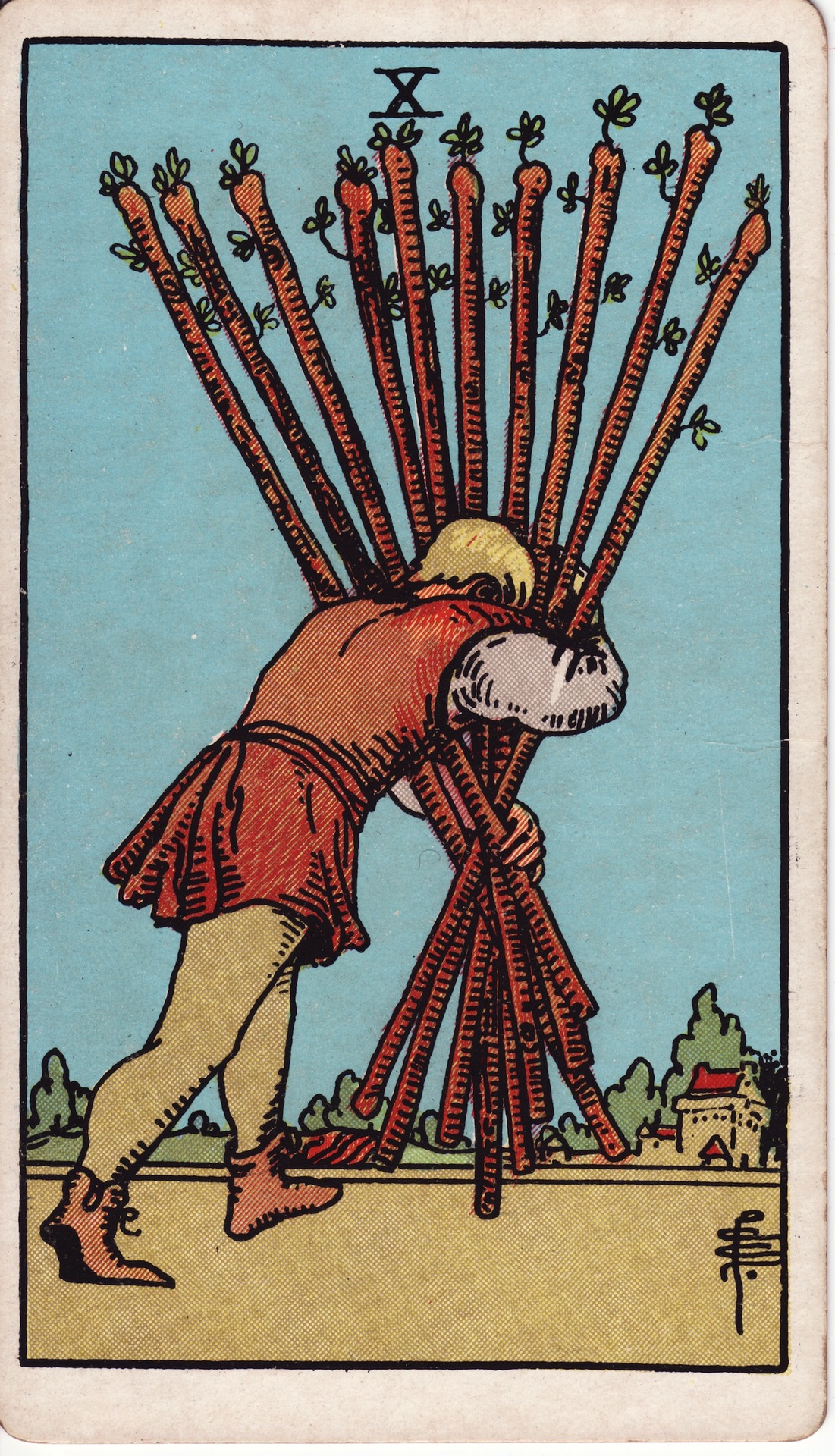
Ten of Wands
The Ten of Wands represents burden, excess responsibility, and the weight of creative force carried beyond its proper limit. In the Rider–Waite deck, a figure struggles forward under the weight of ten heavy wands, vision obscured and posture strained. Where the Nine of Wands endures through resilience, the Ten of Wands shows what happens when endurance becomes overextension. Fire has succeeded; but at great cost.
This card marks the final stage of the Wand cycle, where will has manifested fully yet now presses heavily upon the bearer. What was once inspiration has become obligation.
Esoteric Meaning
In practical interpretation, the Ten of Wands signifies:
- Overwork and exhaustion
- Excessive responsibility
- Burnout and pressure
- Carrying burdens alone
- Success that becomes oppressive
At a deeper level, the Ten of Wands represents will untempered by delegation or release. Creative force has accumulated without being distributed, refined, or concluded. The card teaches that power must be shared or relinquished, or it becomes destructive to its bearer.
In its shadow aspect, the Ten of Wands can indicate martyrdom, inability to say no, or identity fused entirely with responsibility. When purpose becomes weight, the fire dims.
The Ten of Wands on the Tree of Life
In the Golden Dawn system, the Ten of Wands is attributed to Malkuth in Atziluth.
Malkuth represents manifestation and final form. When expressed through Fire, it produces the full materialization of will; including its consequences. The Ten of Wands reflects fire condensed into obligation, effort made tangible as burden.
This is creative force at the limits of sustainability.
Symbolism in the Rider–Waite Deck
Each symbol reinforces strain and excess:
- The Ten Wands: Overaccumulated responsibility
- The Bent Figure: Exhaustion and imbalance
- The Obscured Vision: Loss of perspective
- The Distant Town: Completion near, yet difficult to reach
- The Forward Motion: Persistence despite overload
The Ten of Wands teaches that completion without release is unsustainable.
Role in the Great Work
Within the Great Work, the Ten of Wands represents the final purification of will. After victory, defense, speed, and endurance, the practitioner must confront the cost of carrying too much alone. This is the lesson of surrender; not of purpose, but of excess.
The card teaches that the Work advances through intelligent distribution of energy. Fire must eventually be set down, transformed, or passed forward.
Where the Nine of Wands endures the final test, the Ten of Wands demands release.
FAQ 1: What does the Ten of Wands represent in the Golden Dawn tradition?
In the Golden Dawn, the Ten of Wands represents Fire established in Malkuth; willpower fully descended into material reality. It governs burden, responsibility, and the weight that arises when creative force has been carried to completion.
FAQ 2: Is the Ten of Wands just about being busy or overworked?
No. While effort and strain are present, the Ten of Wands is not mere busyness. In Golden Dawn teaching, it represents the consequences of manifested will, where responsibility accumulates as power becomes fully realized in the physical world.
FAQ 3: How is the Ten of Wands related to the Tree of Life?
The Ten of Wands corresponds to Malkuth in the world of Atziluth. Malkuth signifies manifestation; in Atziluth, this manifests as divine will brought fully into form, carrying the heaviness and obligation that completion entails.
FAQ 4: What elemental force governs the Ten of Wands?
The Ten of Wands is governed by the element of Fire. Here, Fire expresses itself as expended energy; creative force that has been fully projected and now must be borne, managed, or released.
FAQ 5: How does the Ten of Wands function initiatorily?
Initiatorily, the Ten of Wands teaches the initiate to recognize when a cycle is complete. It reveals that power must eventually be redistributed or relinquished, and that continuing to carry finished work leads to unnecessary strain.
FAQ 6: What happens when the Ten of Wands is unbalanced or misunderstood?
When unbalanced, the Ten of Wands may manifest as burnout, martyrdom, or refusal to delegate or conclude. In Golden Dawn doctrine, imbalance occurs when responsibility is clung to rather than consciously released at the end of its cycle.