Ten of Swords
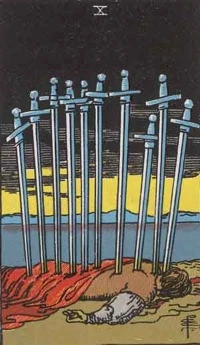
The Ten of Swords represents collapse, finality, and the absolute end of a mental cycle. In the Rider–Waite deck, a figure lies face down with ten swords embedded in their back beneath a dark sky, while a faint light appears on the horizon. Where the Nine of Swords depicts ongoing mental torment, the Ten of Swords marks the moment when suffering can no longer continue. The cycle ends because it has exhausted itself.
This card signifies not defeat alone, but irreversibility. The mind’s structures; beliefs, narratives, fears; have broken completely. Nothing remains to defend or justify.
Esoteric Meaning
In practical interpretation, the Ten of Swords signifies:
- Complete mental collapse
- Endings and finality
- Betrayal or total loss
- Hitting rock bottom
- The end of suffering through exhaustion
At a deeper level, the Ten of Swords represents the destruction of false mental identity. It teaches that when thought is pushed beyond its limits, illusion cannot survive. This is the death of a worldview, not the death of the self.
In its shadow aspect, the Ten of Swords can indicate despair mistaken for permanence, or resistance to the truth that something has already ended. When collapse is denied, suffering lingers unnecessarily.
The Ten of Swords on the Tree of Life
In the Golden Dawn system, the Ten of Swords is attributed to Malkuth in Yetzirah.
Malkuth represents manifestation and materialization. When expressed through Air, it produces the full externalization of mental ruin. The Ten of Swords shows thought made tangible as consequence; ideas collapsing into lived reality.
This is the point where the mind’s constructs fully disintegrate.
Symbolism in the Rider–Waite Deck
Each symbol reinforces total collapse followed by release:
- The Fallen Figure: Ego and identity undone
- The Ten Swords: Excessive mental force carried too far
- The Dark Sky: End of a cycle
- The Rising Light: Renewal after finality
- The Stillness: Suffering completed
The Ten of Swords teaches that when nothing remains, nothing needs to be defended.
Role in the Great Work
Within the Great Work, the Ten of Swords represents the death of destructive mental patterns. This is the final purgation of the intellect when clarity has been misused, resisted, or turned inward destructively. Though painful, this collapse is liberating.
The card teaches that true renewal cannot begin until false structures are completely dismantled. When the mind reaches absolute exhaustion, silence becomes possible.
Where the Nine of Swords prolongs suffering through thought, the Ten of Swords ends it through collapse.
FAQ 1: What does the Ten of Swords represent in the Golden Dawn tradition?
In the Golden Dawn, the Ten of Swords represents Air established in Malkuth; intellectual force fully descended into material reality. It governs finality, collapse of mental constructs, and the point at which thought has reached its absolute limit.
FAQ 2: Is the Ten of Swords about betrayal or victimhood?
No. While betrayal may appear symbolically, the Ten of Swords is not primarily about being wronged. In Golden Dawn teaching, it represents the exhaustion of intellect, where ideas have been pushed beyond usefulness and must end completely.
FAQ 3: How is the Ten of Swords related to the Tree of Life?
The Ten of Swords corresponds to Malkuth in the world of Yetzirah. Malkuth represents manifestation; in Yetzirah, this manifests as thought crystallized into painful reality; mental patterns fully realized and therefore concluded.
FAQ 4: What elemental force governs the Ten of Swords?
The Ten of Swords is governed by the element of Air. Here, Air expresses itself as thought brought to ground; ideas no longer abstract but experienced directly, revealing their ultimate consequences.
FAQ 5: How does the Ten of Swords function initiatorily?
Initiatorily, the Ten of Swords teaches surrender of exhausted thought. The initiate learns that true renewal requires total mental cessation, allowing false or limiting ideas to die so higher insight may arise.
FAQ 6: What happens when the Ten of Swords is unbalanced or misunderstood?
When unbalanced, the Ten of Swords may manifest as despair, nihilism, or identification with defeat. In Golden Dawn doctrine, imbalance occurs when endings are resisted rather than accepted as necessary completion.