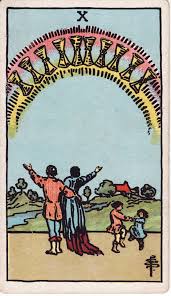
Ten of Cups
The Ten of Cups represents emotional completion, harmony, and shared fulfillment. In the Rider–Waite deck, a family stands beneath a radiant rainbow of ten cups, arms raised in joy as children play nearby. Where the Nine of Cups fulfills personal desire, the Ten of Cups extends that fulfillment into collective harmony. Happiness is no longer private; it is lived and shared.
This card marks the culmination of the emotional journey. Feeling has found equilibrium within relationship, environment, and purpose.
Esoteric Meaning
In practical interpretation, the Ten of Cups signifies:
- Emotional fulfillment and harmony
- Family and community happiness
- Lasting peace
- Emotional security
- Shared joy
At a deeper level, the Ten of Cups represents love stabilized into environment. Water here permeates all aspects of life, creating an atmosphere of belonging and emotional coherence. This card teaches that emotional success reaches its peak when it supports others rather than isolating the self.
In its shadow aspect, the Ten of Cups can indicate idealization of harmony, fear of conflict, or attachment to appearances of happiness. When perfection is clung to, authenticity is threatened.
The Ten of Cups on the Tree of Life
In the Golden Dawn system, the Ten of Cups is attributed to Malkuth in Briah.
Malkuth represents manifestation and lived reality. When expressed through Water, it produces emotional fulfillment fully embodied in the world. The Ten of Cups reflects feeling made visible as home, relationship, and shared life.
This is emotional harmony incarnate.
Symbolism in the Rider–Waite Deck
Each symbol reinforces completion and joy:
- The Rainbow of Cups: Emotional wholeness
- The Family Figures: Shared fulfillment
- The Raised Arms: Gratitude and celebration
- The Open Landscape: Emotional freedom
- The Children: Continuity and renewal
The Ten of Cups teaches that happiness endures when it is lived together.
Role in the Great Work
Within the Great Work, the Ten of Cups represents the completion of the emotional cycle. After illusion, loss, renunciation, and satisfaction, the heart arrives at harmony that is stable, inclusive, and nourishing. This is love realized in daily life.
The card teaches that emotional fulfillment is not escape; it is integration. The Work matures when the heart and world reflect one another.
Where the Nine of Cups satisfies the individual, the Ten of Cups harmonizes the whole.
FAQ 1: What does the Ten of Cups represent in the Golden Dawn tradition?
In the Golden Dawn, the Ten of Cups represents Water established in Malkuth; emotional and intuitive force fully manifested in lived reality. It governs emotional fulfillment made concrete, harmony realized in daily life, and the completion of the emotional cycle.
FAQ 2: Is the Ten of Cups about perfect happiness or ideal relationships?
No. While harmony is present, the Ten of Cups is not an unrealistic ideal. In Golden Dawn teaching, it represents emotional wholeness, where feeling has been integrated, stabilized, and expressed without illusion or excess.
FAQ 3: How is the Ten of Cups related to the Tree of Life?
The Ten of Cups corresponds to Malkuth in the world of Briah. Malkuth represents manifestation; in Briah, this manifests as emotional truth fully grounded; inner harmony reflected outward in relationships and environment.
FAQ 4: What elemental force governs the Ten of Cups?
The Ten of Cups is governed by the element of Water. Here, Water expresses itself as fulfilled emotional flow; feeling that has reached completion and now supports life rather than seeking satisfaction.
FAQ 5: How does the Ten of Cups function initiatorily?
Initiatorily, the Ten of Cups teaches the initiate to recognize fulfillment without attachment. It marks the moment when emotional harmony is experienced as a foundation, not a goal, allowing the Work to continue without craving.
FAQ 6: What happens when the Ten of Cups is unbalanced or misunderstood?
When unbalanced, the Ten of Cups may manifest as denial of conflict, idealization of harmony, or resistance to change. In Golden Dawn doctrine, imbalance occurs when completion is mistaken for permanence and emotional fulfillment is clung to rather than lived.