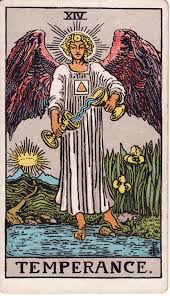
Temperance
Temperance represents integration, balance, and the harmonization of opposites after transformation. In the Rider–Waite deck, an angel calmly pours liquid between two cups, one foot on land and the other in water, symbolizing equilibrium between worlds. Where Death ends what must be released, Temperance reconstructs, blending purified elements into a new, stable form.
Numbered XIV, Temperance signifies moderation not as restraint, but as intelligent synthesis. It is the art of combination: bringing together disparate forces in proper proportion to create something greater than either alone.
Esoteric Meaning
In practical interpretation, Temperance signifies:
- Balance and moderation
- Integration and healing
- Alchemical blending
- Harmony and flow
- Patience and adaptation
At a deeper level, Temperance represents the alchemical stage of recombination. After dissolution comes refinement; careful, deliberate, and precise. This card teaches that transformation is completed not through extremes, but through balance and cooperation.
In its shadow aspect, Temperance can indicate imbalance, excess, or fragmentation. When synthesis is avoided, the practitioner oscillates between extremes rather than stabilizing growth.
Temperance on the Tree of Life
In the Golden Dawn system, Temperance corresponds to the Hebrew letter Samekh (ס) and is assigned to Path 25 on the Tree of Life.
- Path: 25
- Connects: Tiphareth (Beauty) → Yesod (Foundation)
- Hebrew Letter: Samekh
- Astrological Attribution: Sagittarius
Samekh means “prop” or “support,” symbolizing stability through alignment. This path channels the harmonized self of Tiphareth into the subconscious and formative realm of Yesod. Temperance stabilizes transformation so it can be expressed consistently rather than episodically.
Sagittarius governs direction, synthesis, and higher purpose, reflecting Temperance’s role in aligning inner transformation with outward trajectory.
Symbolism in the Rider–Waite Deck
Each symbol reinforces deliberate integration:
- The Flowing Cups: Alchemical transmutation
- One Foot on Land, One in Water: Balance of conscious and unconscious
- The Angel: Higher guidance and equilibrium
- The Path to the Sun: Integration leading toward illumination
- The Iris Flowers: Renewal and harmony
Temperance does not rush transformation; it refines it.
Role in the Great Work
Within the Great Work, Temperance represents the stage of stabilization after rebirth. After profound endings and transformation, the practitioner must now integrate lessons into daily life. This is the work of balance; making transformation sustainable.
Temperance teaches that the Great Work is not completed through destruction alone, but through careful reconstruction. True mastery lies in maintaining harmony over time.
Where Death clears the ground, Temperance builds coherence.
FAQ 1: What does Temperance represent in the Golden Dawn tradition?
In the Golden Dawn, Temperance represents alchemical integration and recomposition. It governs the blending of purified forces into a new, harmonious structure after transformation has occurred.
FAQ 2: Is Temperance simply about moderation or balance?
No. Temperance is not merely moderation. In Golden Dawn doctrine, it represents active synthesis—the conscious recombination of opposites into a higher unity through spiritual intelligence rather than restraint alone.
FAQ 3: How is Temperance associated with the Tree of Life?
Temperance corresponds to the path connecting Yesod (Foundation) to Tiphareth (Beauty). This path represents the harmonization of subconscious force with conscious identity, allowing purified energy to circulate coherently.
FAQ 4: What planetary or zodiacal force is associated with Temperance?
In the Golden Dawn system, Temperance is associated with Sagittarius and ruled by Jupiter. This reflects spiritual integration guided by wisdom, proportion, and the unifying principle of higher meaning.
FAQ 5: How does Temperance function initiatorily?
Initiatorily, Temperance follows Death by rebuilding what was dissolved. It tests whether transformation can be stabilized into a functional, harmonious whole rather than collapsing back into fragmentation or excess.
FAQ 6: What happens when Temperance is unbalanced or misunderstood?
When misunderstood, Temperance may appear as passivity or compromise. In Golden Dawn teaching, imbalance occurs when integration lacks purpose. Properly expressed, Temperance produces coherence, adaptability, and spiritual equilibrium.
FAQ 7: Why is Temperance essential to the Great Work?
Temperance is essential because the Great Work does not end with destruction. After death comes recomposition. Temperance ensures that transformation results in a living, functional synthesis capable of sustaining spiritual realization.