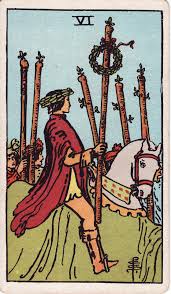
Six of Wands
The Six of Wands represents victory, recognition, and the unification of will after conflict. In the Rider–Waite deck, a crowned figure rides triumphantly through a crowd, laurel wreath raised high as others acknowledge his success. Where the Five of Wands depicts chaotic competition and fragmented effort, the Six of Wands shows fire brought back under command. Strife has produced a clear outcome.
This card marks the moment when leadership emerges. Creative force no longer clashes aimlessly; it aligns around a central direction and is publicly affirmed.
Esoteric Meaning
In practical interpretation, the Six of Wands signifies:
- Victory and success
- Recognition and acclaim
- Leadership and confidence
- Achievement after struggle
- Public acknowledgment
At a deeper level, the Six of Wands represents will harmonized with purpose. Fire has been tested through conflict and now stands victorious, not merely because it overpowered others, but because it proved coherent and compelling. This card teaches that true victory unites rather than divides.
In its shadow aspect, the Six of Wands can indicate ego inflation, dependence on external validation, or hollow triumph. When recognition replaces purpose, the fire weakens again.
The Six of Wands on the Tree of Life
In the Golden Dawn system, the Six of Wands is attributed to Tiphareth in Atziluth.
Tiphareth represents harmony, balance, and the true center of the self. When expressed through Fire, it produces victory aligned with inner purpose. The Six of Wands reflects success that resonates because it is integrated rather than forced.
This is triumph that reflects alignment with the Work.
Symbolism in the Rider–Waite Deck
Each symbol reinforces recognition and unified will:
- The Laurel Wreath: Victory and achievement
- The Crowned Rider: Legitimate leadership
- The Raised Wand: Accomplished creative force
- The Crowd: Collective acknowledgment
- The Upright Horse: Controlled momentum
The Six of Wands teaches that leadership is confirmed when others recognize coherence.
Role in the Great Work
Within the Great Work, the Six of Wands represents the first true success of applied will. After conflict and fragmentation, the practitioner experiences confirmation that purpose is aligned and effective. This is not the end of the Work, but proof that it is viable.
The card teaches humility alongside confidence. Victory must be carried forward responsibly, or it collapses back into ego-driven conflict.
Where the Five of Wands scatters fire through strife, the Six of Wands unites it through victory.
FAQ 1: What does the Six of Wands represent in the Golden Dawn tradition?
In the Golden Dawn, the Six of Wands represents the harmonization of Fire; will restored to balance and recognized in its proper form. It governs legitimate authority, earned recognition, and victory aligned with higher purpose.
FAQ 2: Is the Six of Wands about ego, pride, or public praise?
No. While recognition may appear externally, the Six of Wands is not about ego gratification. In Golden Dawn teaching, it represents rightful success, where will has been purified through conflict and now stands in alignment with order and harmony.
FAQ 3: How is the Six of Wands related to the Tree of Life?
The Six of Wands corresponds to Tiphareth in the world of Atziluth. Tiphareth represents harmony and beauty; in Atziluth, this manifests as balanced will, enlightened leadership, and authority that serves a greater law.
FAQ 4: What elemental force governs the Six of Wands?
The Six of Wands is governed by the element of Fire. Here, Fire expresses itself as disciplined power; creative force that has been refined and now operates without chaos or domination.
FAQ 5: How does the Six of Wands function initiatorily?
Initiatorily, the Six of Wands teaches humility in victory. The initiate learns that true authority arises not from conquest, but from alignment, self-mastery, and service to the Work rather than personal glory.
FAQ 6: What happens when the Six of Wands is unbalanced or misunderstood?
When unbalanced, the Six of Wands may manifest as arrogance, dependence on validation, or hollow triumph. In Golden Dawn doctrine, imbalance occurs when recognition replaces responsibility and authority loses its connection to harmony.