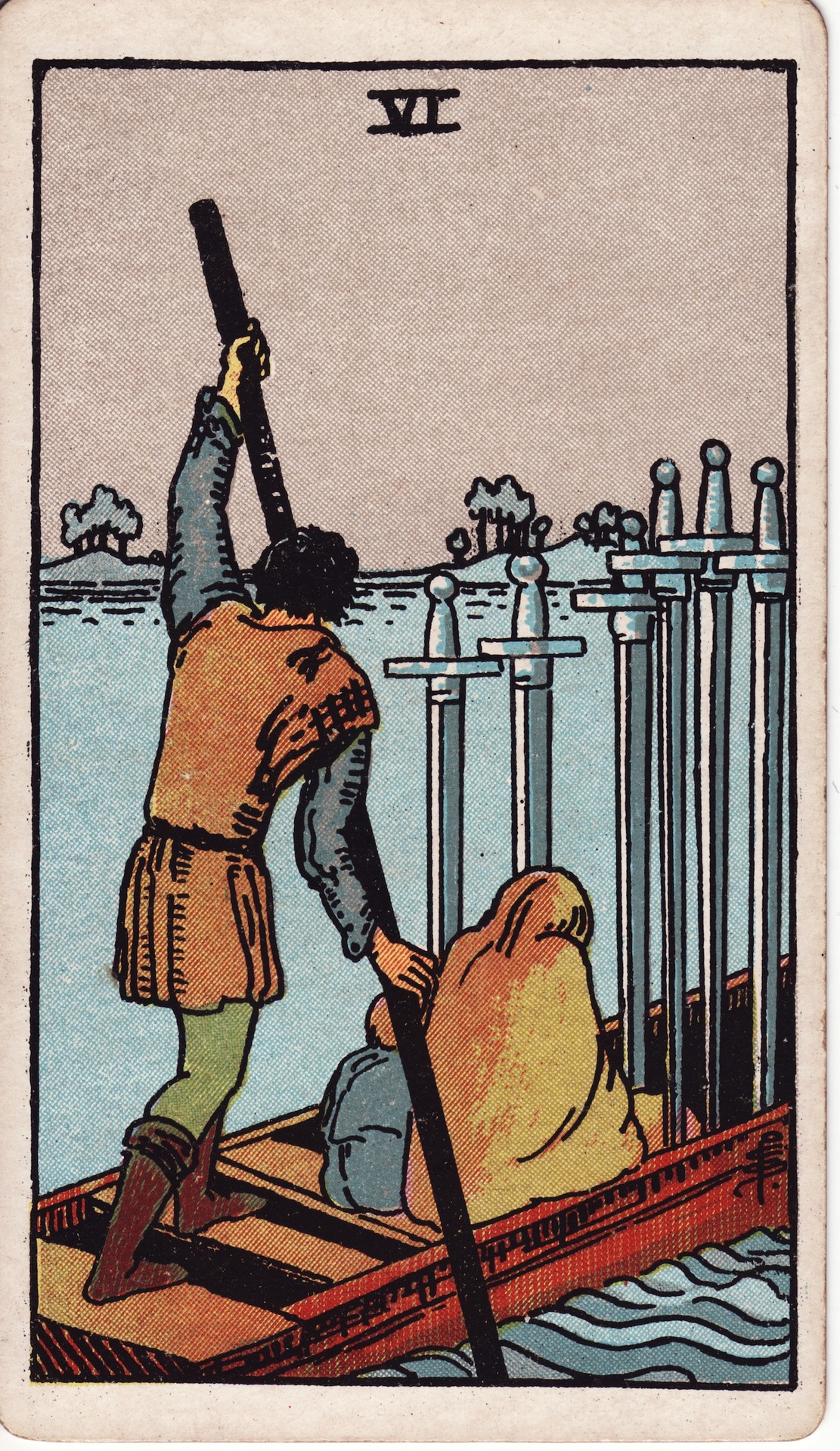
Six of Swords
The Six of Swords represents transition, recovery, and movement away from conflict toward calmer understanding. In the Rider–Waite deck, figures travel across water in a small boat, leaving rough shores behind while carrying six swords with them. Where the Five of Swords depicts conflict and hollow victory, the Six of Swords offers escape from turmoil; not through denial, but through conscious withdrawal.
This card marks a passage rather than a destination. Difficult truths remain present, but the environment in which they are processed becomes more stable.
Esoteric Meaning
In practical interpretation, the Six of Swords signifies:
- Transition and relocation
- Moving away from conflict
- Mental recovery
- Gradual improvement
- Passage through difficulty
At a deeper level, the Six of Swords represents integration through distance. It teaches that clarity sometimes requires physical or psychological removal from chaos. Healing begins when the mind is no longer under constant attack.
In its shadow aspect, the Six of Swords can indicate avoidance, emotional disengagement, or carrying unresolved issues into new contexts. When movement replaces integration, patterns repeat.
The Six of Swords on the Tree of Life
In the Golden Dawn system, the Six of Swords is attributed to Tiphareth in Yetzirah.
Tiphareth represents harmony, balance, and integration. When expressed through Air, it produces mental equilibrium restored after conflict. The Six of Swords reflects success achieved not through conquest, but through wisdom and restraint.
This is clarity stabilized through conscious movement.
Symbolism in the Rider–Waite Deck
Each symbol reinforces transition and recovery:
- The Boat: Vehicle of passage
- The Calm Waters Ahead: Mental relief
- The Rough Waters Behind: Past turmoil
- The Hooded Figures: Emotional withdrawal
- The Upright Swords: Lessons carried forward
The Six of Swords teaches that healing requires movement with intention.
Role in the Great Work
Within the Great Work, the Six of Swords represents the restoration of mental balance through transition. After ethical conflict and misuse of intellect, the practitioner must relocate; internally or externally; to integrate lessons learned.
This card teaches that wisdom sometimes lies in leaving rather than winning. Progress resumes when the mind is given space to realign.
Where the Five of Swords corrupts clarity through conflict, the Six of Swords rescues it through distance.
FAQ 1: What does the Six of Swords represent in the Golden Dawn tradition?
In the Golden Dawn, the Six of Swords represents the harmonization of Air; the mind restored to balance after conflict. It governs transition guided by clarity, the movement from turbulence into ordered understanding.
FAQ 2: Is the Six of Swords about escape or avoiding problems?
No. While movement away from difficulty may be shown, the Six of Swords is not avoidance. In Golden Dawn teaching, it represents conscious transition, where the mind chooses a higher order of thought rather than remaining in conflict.
FAQ 3: How is the Six of Swords related to the Tree of Life?
The Six of Swords corresponds to Tiphareth in the world of Yetzirah. Tiphareth brings harmony; in Yetzirah, this manifests as mental balance, guided reasoning, and the restoration of inner coherence.
FAQ 4: What elemental force governs the Six of Swords?
The Six of Swords is governed by the element of Air. Here, Air expresses itself as clarity in motion; the capacity to carry thought forward without fragmentation or hostility.
FAQ 5: How does the Six of Swords function initiatorily?
Initiatorily, the Six of Swords teaches discernment in movement. The initiate learns to leave conflict behind without denial, carrying lessons forward into calmer and more ordered states of consciousness.
FAQ 6: What happens when the Six of Swords is unbalanced or misunderstood?
When unbalanced, the Six of Swords may manifest as emotional detachment, intellectual avoidance, or perpetual transition. In Golden Dawn doctrine, imbalance occurs when movement replaces resolution rather than completing it.