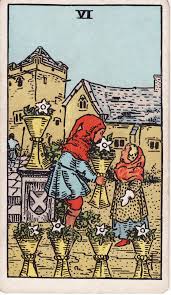
Six of Cups
The Six of Cups represents emotional restoration, memory, and the gentle return of joy. In the Rider–Waite deck, a figure offers a cup filled with flowers to a child, set within a quiet, protected space. Where the Five of Cups confronts grief and loss, the Six of Cups introduces healing through remembrance. Feeling softens and reorients toward what is simple, sincere, and enduring.
This card marks the moment when the heart recovers its innocence; not by denying pain, but by reconnecting with what preceded it.
Esoteric Meaning
In practical interpretation, the Six of Cups signifies:
- Nostalgia and memory
- Innocence and simplicity
- Emotional healing
- Kindness and generosity
- Reconnection with the past
At a deeper level, the Six of Cups represents pleasure purified of excess and illusion. Water here returns to balance after rupture. This card teaches that emotional restoration often comes not from new experience, but from remembering what was once whole.
In its shadow aspect, the Six of Cups can indicate escapism, idealization of the past, or resistance to present growth. When memory replaces engagement, healing stalls.
The Six of Cups on the Tree of Life
In the Golden Dawn system, the Six of Cups is attributed to Tiphareth in Briah.
Tiphareth represents harmony, balance, and the restored center. When expressed through Water, it produces emotional equilibrium and sincere joy. The Six of Cups reflects feeling returned to its proper proportion; neither excessive nor withdrawn.
This is the heart realigned after sorrow.
Symbolism in the Rider–Waite Deck
Each symbol reinforces emotional healing and gentleness:
- The Flower-Filled Cups: Pure, uncomplicated joy
- The Child Figures: Innocence and openness
- The Protected Space: Safety and trust
- The Exchange Gesture: Giving without expectation
- The Still Atmosphere: Emotional calm
The Six of Cups teaches that healing arrives through gentleness rather than intensity.
Role in the Great Work
Within the Great Work, the Six of Cups represents the restoration of the heart after loss. After grief breaks emotional rigidity, memory and innocence return—not as regression, but as renewal. The practitioner reconnects with sincerity of intention.
The card teaches that joy is not naïve when it is conscious. Emotional truth deepens when it remembers its original source.
Where the Five of Cups mourns what was lost, the Six of Cups recovers what remains true.
FAQ 1: What does the Six of Cups represent in the Golden Dawn tradition?
In the Golden Dawn, the Six of Cups represents the harmonization of Water; emotional and intuitive forces restored to balance after sorrow. It governs emotional reconciliation, inner peace, and the return of feeling to a state of innocence and clarity.
FAQ 2: Is the Six of Cups only about nostalgia or childhood memories?
No. While memories and the past may appear, the Six of Cups is not sentimental nostalgia. In Golden Dawn teaching, it represents purified emotional memory, where past experience is healed and reintegrated rather than clung to.
FAQ 3: How is the Six of Cups related to the Tree of Life?
The Six of Cups corresponds to Tiphareth in the world of Briah. Tiphareth restores harmony; in Briah, this manifests as emotional balance, healed intuition, and the reconciliation of feeling with spiritual purpose.
FAQ 4: What elemental force governs the Six of Cups?
The Six of Cups is governed by the element of Water. Here, Water expresses itself as calm emotional flow, sincerity of feeling, and the capacity to experience joy without attachment or dependency.
FAQ 5: How does the Six of Cups function initiatorily?
Initiatorily, the Six of Cups teaches emotional integration. The initiate learns to recover purity of feeling without regression, allowing joy, memory, and compassion to arise from wholeness rather than longing.
FAQ 6: What happens when the Six of Cups is unbalanced or misunderstood?
When unbalanced, the Six of Cups may manifest as escapism, idealization of the past, or emotional immaturity. In Golden Dawn doctrine, imbalance occurs when memory replaces presence and harmony becomes stagnation.