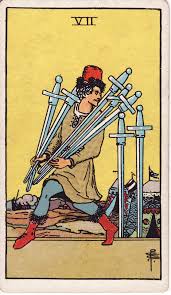
Seven of Swords
The Seven of Swords represents strategy, deception, and intellect operating without ethical alignment. In the Rider–Waite deck, a figure stealthily carries away swords from a camp, glancing backward in caution. Where the Six of Swords departs conflict openly for healing, the Seven of Swords chooses a covert path. This is movement driven by self-interest rather than harmony.
This card marks a turn toward cleverness without integrity—where the mind seeks advantage instead of resolution. Success may be achieved temporarily, but stability is compromised.
Esoteric Meaning
In practical interpretation, the Seven of Swords signifies:
- Deception or secrecy
- Strategic withdrawal
- Avoidance of responsibility
- Intellectual manipulation
- Acting alone or without disclosure
At a deeper level, the Seven of Swords represents fragmented intellect. Thought becomes disconnected from conscience and community. The card teaches that intelligence used in isolation breeds instability, mistrust, and eventual collapse.
In its shadow aspect, the Seven of Swords can indicate self-deception, paranoia, or rationalizing unethical behavior. When intellect justifies avoidance, clarity dissolves into cunning.
The Seven of Swords on the Tree of Life
In the Golden Dawn system, the Seven of Swords is attributed to Netzach in Yetzirah.
Netzach governs desire, endurance, and emotional motivation. When expressed through Air, it produces clever but inconsistent mental effort. The Seven of Swords reflects intellect driven by desire rather than truth.
This is strategy without foundation.
Symbolism in the Rider–Waite Deck
Each symbol reinforces instability and moral ambiguity:
- The Thief Figure: Acting outside shared order
- The Stolen Swords: Knowledge taken without responsibility
- The Remaining Swords: Incomplete victory
- The Backward Glance: Fear of consequence
- The Camp: Community bypassed rather than engaged
The Seven of Swords teaches that secrecy trades short-term gain for long-term instability.
Role in the Great Work
Within the Great Work, the Seven of Swords represents the temptation to bypass integration. After transition and recovery, the practitioner may attempt to avoid unresolved truth through cleverness, withdrawal, or rationalization.
The card warns that intellect severed from ethics undermines the Work. Progress achieved through deception cannot be sustained.
Where the Six of Swords moves away from conflict with awareness, the Seven of Swords escapes without resolution.
FAQ 1: What does the Seven of Swords represent in the Golden Dawn tradition?
In the Golden Dawn, the Seven of Swords represents Air under endurance; the intellect operating under pressure, desire, and uncertainty. It governs strategy, selective withdrawal, and the use of intelligence to navigate unstable or hostile conditions.
FAQ 2: Is the Seven of Swords always about deception or dishonesty?
No. While deception can be present, the Seven of Swords is not inherently immoral. In Golden Dawn teaching, it represents strategic separation, where the mind chooses indirect methods when direct confrontation would be ineffective or destructive.
FAQ 3: How is the Seven of Swords related to the Tree of Life?
The Seven of Swords corresponds to Netzach in the world of Yetzirah. Netzach governs endurance and desire; in Yetzirah, this manifests as sustained mental maneuvering, strategic thinking, and the testing of intellectual integrity under pressure.
FAQ 4: What elemental force governs the Seven of Swords?
The Seven of Swords is governed by the element of Air. Here, Air expresses itself as cunning, adaptability, and the capacity to navigate complexity through thought rather than force.
FAQ 5: How does the Seven of Swords function initiatorily?
Initiatorily, the Seven of Swords teaches discernment and self-reliance. The initiate learns when to withdraw mentally, when to act independently, and how to protect the Work from exposure, interference, or premature confrontation.
FAQ 6: What happens when the Seven of Swords is unbalanced or misunderstood?
When unbalanced, the Seven of Swords may manifest as paranoia, manipulation, or habitual avoidance. In Golden Dawn doctrine, imbalance occurs when strategy replaces truth and separation becomes isolation.