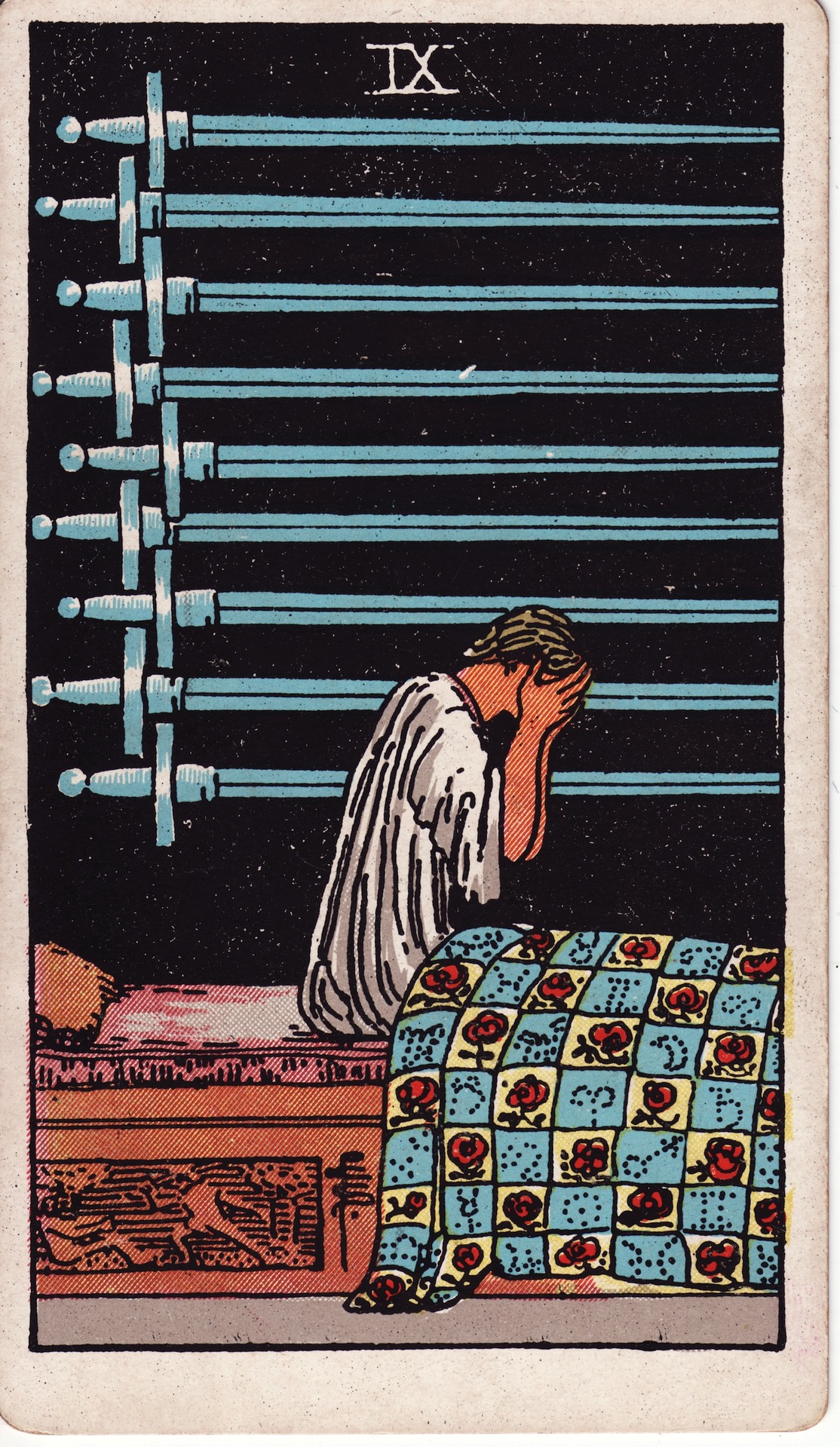
Nine of Swords
The Nine of Swords represents anxiety, guilt, and torment arising from the unchecked mind. In the Rider–Waite deck, a figure sits upright in bed, face buried in their hands, while nine swords hang ominously on the wall behind them. Where the Eight of Swords depicts perceived restriction, the Nine of Swords reveals the internal consequence of that restriction; psychological suffering generated entirely within consciousness.
This card marks the point where thought turns relentlessly against the self. There is no external enemy here; the conflict is internal, cyclical, and exhausting.
Esoteric Meaning
In practical interpretation, the Nine of Swords signifies:
- Anxiety and mental anguish
- Guilt, regret, or remorse
- Insomnia and intrusive thoughts
- Fear magnified by imagination
- Psychological suffering
At a deeper level, the Nine of Swords represents intellect severed from compassion. The mind rehearses failure, blame, and fear without resolution. This card teaches that suffering intensifies when thought is allowed to spiral without grounding in reality or mercy.
In its shadow aspect, the Nine of Swords can indicate self-punishment, obsession, or refusal to forgive oneself. When suffering becomes identity, clarity cannot return.
The Nine of Swords on the Tree of Life
In the Golden Dawn system, the Nine of Swords is attributed to Yesod in Yetzirah.
- Sephirah: Yesod
- World: Yetzirah (World of Formation)
- Element: Air
- Title: Lord of Despair and Cruelty
Yesod governs the subconscious, dreams, and inner imagery. When expressed through Air, it produces mental suffering amplified by imagination. The Nine of Swords reflects fear made vivid through repetitive inner imagery rather than external reality.
This is anxiety generated by the subconscious mind feeding the intellect.
Symbolism in the Rider–Waite Deck
Each symbol reinforces internal torment:
- The Sitting Figure: Awakening into distress
- The Hanging Swords: Thoughts looming over consciousness
- The Darkened Room: Isolation within the mind
- The Bed: Vulnerability and exposure
- The Patterned Blanket: Subconscious symbolism
The Nine of Swords teaches that suffering is often loudest in silence.
Role in the Great Work
Within the Great Work, the Nine of Swords represents the darkest trial of the intellect. After restriction and paralysis, the practitioner must face the emotional consequences of unintegrated thought. This is the night where fear, guilt, and regret surface without distraction.
The lesson here is compassion toward the self. The Work cannot advance while the mind punishes itself endlessly. Recognition, forgiveness, and grounding are required for release.
Where the Eight of Swords traps through belief, the Nine of Swords torments through imagination.
FAQ 1: What does the Nine of Swords represent in the Golden Dawn tradition?
In the Golden Dawn, the Nine of Swords represents Air established in Yesod; thought fully internalized within the subconscious. It governs mental echoes, inner conflict, and the amplification of unresolved ideas within the astral and psychic sphere.
FAQ 2: Is the Nine of Swords only about anxiety or fear?
No. While anxiety may manifest, the Nine of Swords is not merely emotional distress. In Golden Dawn teaching, it represents unresolved thought patterns, where intellect turns inward and magnifies itself without grounding or resolution.
FAQ 3: How is the Nine of Swords related to the Tree of Life?
The Nine of Swords corresponds to Yesod in the world of Yetzirah. Yesod governs the subconscious; in Yetzirah, this manifests as persistent mental imagery, rumination, and thought-forms repeating within the astral mind.
FAQ 4: What elemental force governs the Nine of Swords?
The Nine of Swords is governed by the element of Air. Here, Air expresses itself as self-referential thought; analysis turned inward, creating cycles of worry, guilt, or mental fixation.
FAQ 5: How does the Nine of Swords function initiatorily?
Initiatorily, the Nine of Swords teaches awareness of subconscious thought. The initiate learns that unchecked intellect can become torment, and that mental clarity requires integration with higher guidance rather than endless internal analysis.
FAQ 6: What happens when the Nine of Swords is unbalanced or misunderstood?
When unbalanced, the Nine of Swords may manifest as insomnia, anxiety loops, or obsessive guilt. In Golden Dawn doctrine, imbalance occurs when mental force remains trapped in Yesod without ascent toward harmony or illumination.