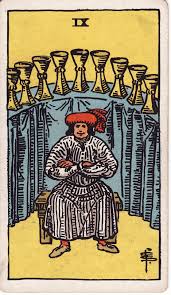
Nine of Cups
The Nine of Cups represents contentment, satisfaction, and emotional fulfillment realized in the present moment. In the Rider–Waite deck, a seated figure rests confidently before a curved display of nine cups, arms folded in calm assurance. Where the Eight of Cups walks away in search of deeper meaning, the Nine of Cups depicts arrival. The heart finds pleasure that is conscious, grounded, and earned.
This card marks the point where emotional desire has been clarified and fulfilled—not through illusion, but through discernment and choice.
In practical interpretation, the Nine of Cups signifies:
- Emotional satisfaction
- Contentment and pleasure
- Gratitude and enjoyment
- Fulfilled desire
- Personal happiness
At a deeper level, the Nine of Cups represents pleasure aligned with self-knowledge. Water here settles into abundance without excess. This card teaches that fulfillment is sustainable when desire has been purified through experience and renunciation.
In its shadow aspect, the Nine of Cups can indicate smugness, indulgence, or complacency. When satisfaction becomes self-absorption, growth stagnates.
The Nine of Cups on the Tree of Life
In the Golden Dawn system, the Nine of Cups is attributed to Yesod in Briah.
Yesod governs foundation, reflection, and the subconscious. When expressed through Water, it produces emotional satisfaction rooted in inner stability. The Nine of Cups reflects feeling supported by a coherent inner world rather than external validation.
This is happiness that rests on inner alignment.
Symbolism in the Rider–Waite Deck
Each symbol reinforces grounded fulfillment:
- The Curved Cups: Emotional abundance contained
- The Seated Figure: Comfort and security
- The Crossed Arms: Self-sufficiency
- The Draped Table: Enjoyment without excess
- The Calm Expression: Emotional peace
The Nine of Cups teaches that joy deepens when desire rests.
Role in the Great Work
Within the Great Work, the Nine of Cups represents the reward of emotional discernment. After illusion is abandoned and attachment released, the heart experiences satisfaction without dependency. This is pleasure that does not distract from the Work; it supports it.
The card teaches gratitude. Fulfillment becomes sacred when it is recognized as temporary yet meaningful.
Where the Eight of Cups seeks meaning beyond pleasure, the Nine of Cups finds peace within it.
FAQ 1: What does the Nine of Cups represent in the Golden Dawn tradition?
In the Golden Dawn, the Nine of Cups represents Water established in Yesod; emotional and intuitive force fully internalized. It governs inner contentment, emotional satisfaction, and the sense of fulfillment that arises when desire is harmonized within the subconscious foundation.
FAQ 2: Is the Nine of Cups just about wishes coming true or indulgence?
No. While satisfaction is present, the Nine of Cups is not shallow gratification. In Golden Dawn teaching, it represents stable emotional fulfillment, where desire has been integrated rather than endlessly pursued.
FAQ 3: How is the Nine of Cups related to the Tree of Life?
The Nine of Cups corresponds to Yesod in the world of Briah. Yesod forms the psychic foundation; in Briah, this manifests as emotional coherence, intuitive stability, and a settled inner state free from longing or excess.
FAQ 4: What elemental force governs the Nine of Cups?
The Nine of Cups is governed by the element of Water. Here, Water expresses itself as emotional completeness; feeling that is full, balanced, and no longer seeking external validation.
FAQ 5: How does the Nine of Cups function initiatorily?
Initiatorily, the Nine of Cups teaches emotional sovereignty. The initiate learns that true satisfaction arises from inner alignment, not from accumulation or external approval.
FAQ 6: What happens when the Nine of Cups is unbalanced or misunderstood?
When unbalanced, the Nine of Cups may manifest as complacency, self-indulgence, or emotional stagnation. In Golden Dawn doctrine, imbalance occurs when fulfillment turns inward without higher aspiration or service to the Work.