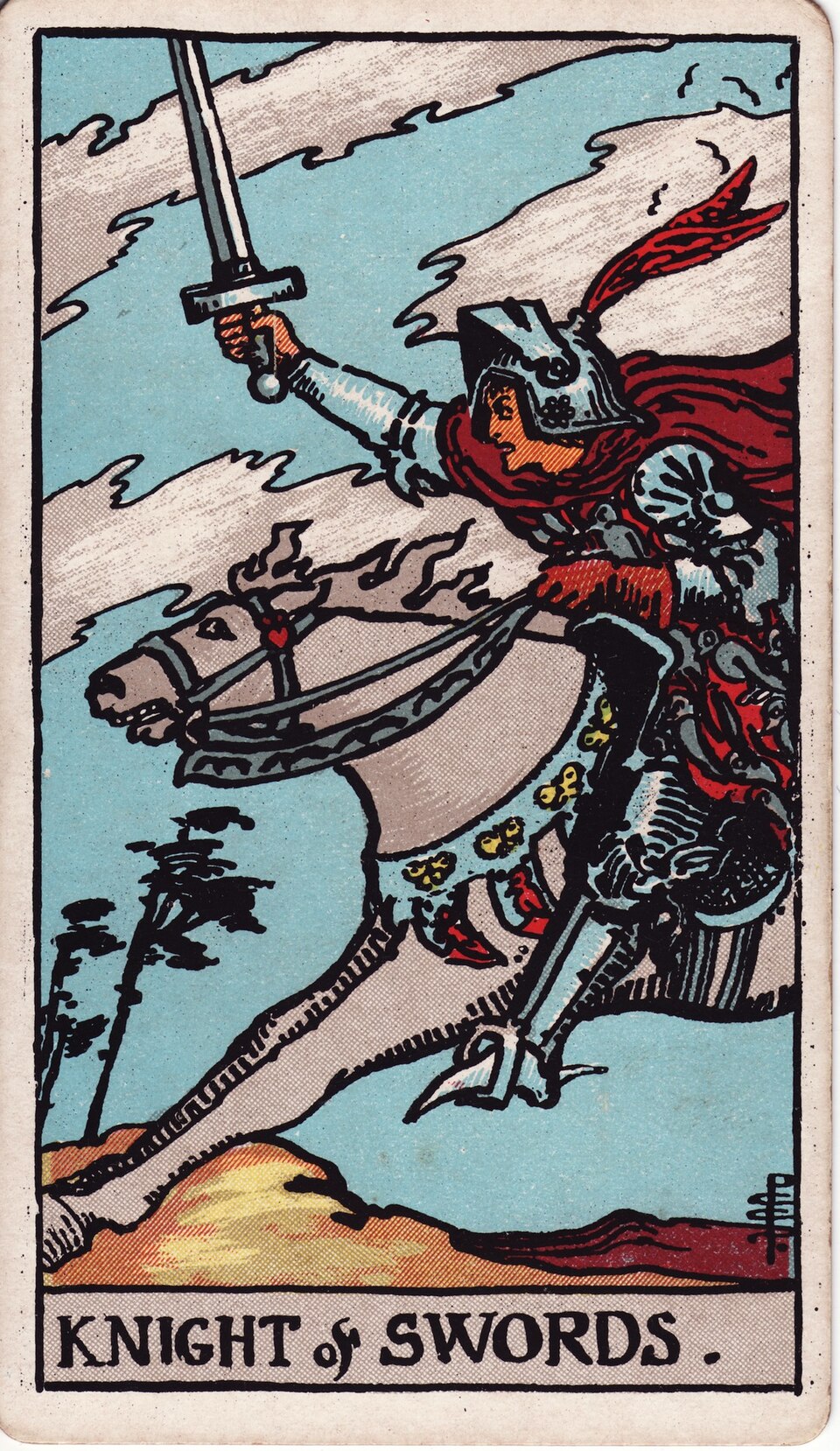
Knight of Swords
The Knight of Swords represents intellectual force, urgency, and the aggressive application of reason. In the Rider–Waite deck, the knight charges forward at full speed, sword raised, wind and clouds whipping violently around him. Where the Page of Swords observes and questions, the Knight of Swords acts immediately. Thought becomes motion, and insight becomes confrontation.
This card embodies the moment when ideas demand expression without delay. It is the mind convinced of its direction and unwilling to wait for consensus or caution.
In practical interpretation, the Knight of Swords signifies:
- Swift action and decisiveness
- Intellectual confrontation
- Argument and debate
- Urgency and momentum
- Single-minded pursuit of truth
At a deeper level, the Knight of Swords represents thought ignited by will. Fire animates Air, producing speed, intensity, and drive. This is intellect used as a weapon; capable of clearing obstacles quickly, but also of causing damage when restraint is absent.
In its shadow aspect, the Knight of Swords can indicate recklessness, verbal aggression, or obsession with being right. When intellect outruns wisdom, destruction follows clarity.
The Knight of Swords in the Golden Dawn System
In the Golden Dawn system, the Knight of Swords corresponds to Fire of Air and is titled the Prince of Swords.
- Element: Fire of Air
- Realm: Tiphareth acting through Yetzirah
- Function: Activation and force of thought
The Prince represents dynamic expression. Fire within Air creates rapid ideation, sharp language, and decisive confrontation. This is the intellect at full acceleration.
The Knight of Swords asks not should this be said, but can it be said now.
Symbolism in the Rider–Waite Deck
Each symbol reinforces speed and intensity:
- The Charging Horse: Unrestrained momentum
- The Raised Sword: Intellectual assertion
- The Stormy Sky: Mental turbulence
- The Wind-Bent Trees: Force impacting the environment
- The Knight’s Forward Gaze: Fixation on objective
The Knight advances regardless of terrain.
Role in the Great Work
Within the Great Work, the Knight of Swords represents the trial of intellectual force. After curiosity awakens, the practitioner may rush to impose understanding upon the world. This card tests whether clarity is guided by wisdom or driven by ego.
The Knight teaches that speed magnifies both truth and error. Insight delivered without timing or compassion fractures rather than liberates.
Where the Page of Swords learns to observe, the Knight of Swords demands immediate expression.
FAQ 1: What does the Knight of Swords represent in the Golden Dawn tradition?
In the Golden Dawn, the Knight of Swords represents Air set into motion; intellectual force actively advancing through assertion, speed, and decisive thought. It governs momentum, clarity in action, and the drive to cut through confusion.
FAQ 2: Is the Knight of Swords reckless or uncontrolled?
No. While intensity and speed are present, the Knight of Swords is not inherently reckless. In Golden Dawn teaching, it represents focused mental force, where thought becomes action and ideas are pursued with conviction.
FAQ 3: How do Knight cards function in the Golden Dawn court system?
In the Golden Dawn system, Knights represent active force and propulsion. They are the “fire of the element,” showing how elemental power moves outward, engages opposition, and asserts itself in the world.
FAQ 4: What elemental forces govern the Knight of Swords?
The Knight of Swords is governed by Fire acting through Air. This combination produces rapid thinking, verbal force, and the ability to initiate change through decisive communication and intellectual action.
FAQ 5: How does the Knight of Swords function initiatorily?
Initiatorily, the Knight of Swords teaches the initiate right use of mental power. It represents the phase where clarity must be matched with discipline, ensuring that speed serves truth rather than impulse.
FAQ 6: What happens when the Knight of Swords is unbalanced or misunderstood?
When unbalanced, the Knight of Swords may manifest as impulsiveness, argumentativeness, or intellectual aggression. In Golden Dawn doctrine, imbalance occurs when motion outruns wisdom and thought becomes destructive rather than illuminating.