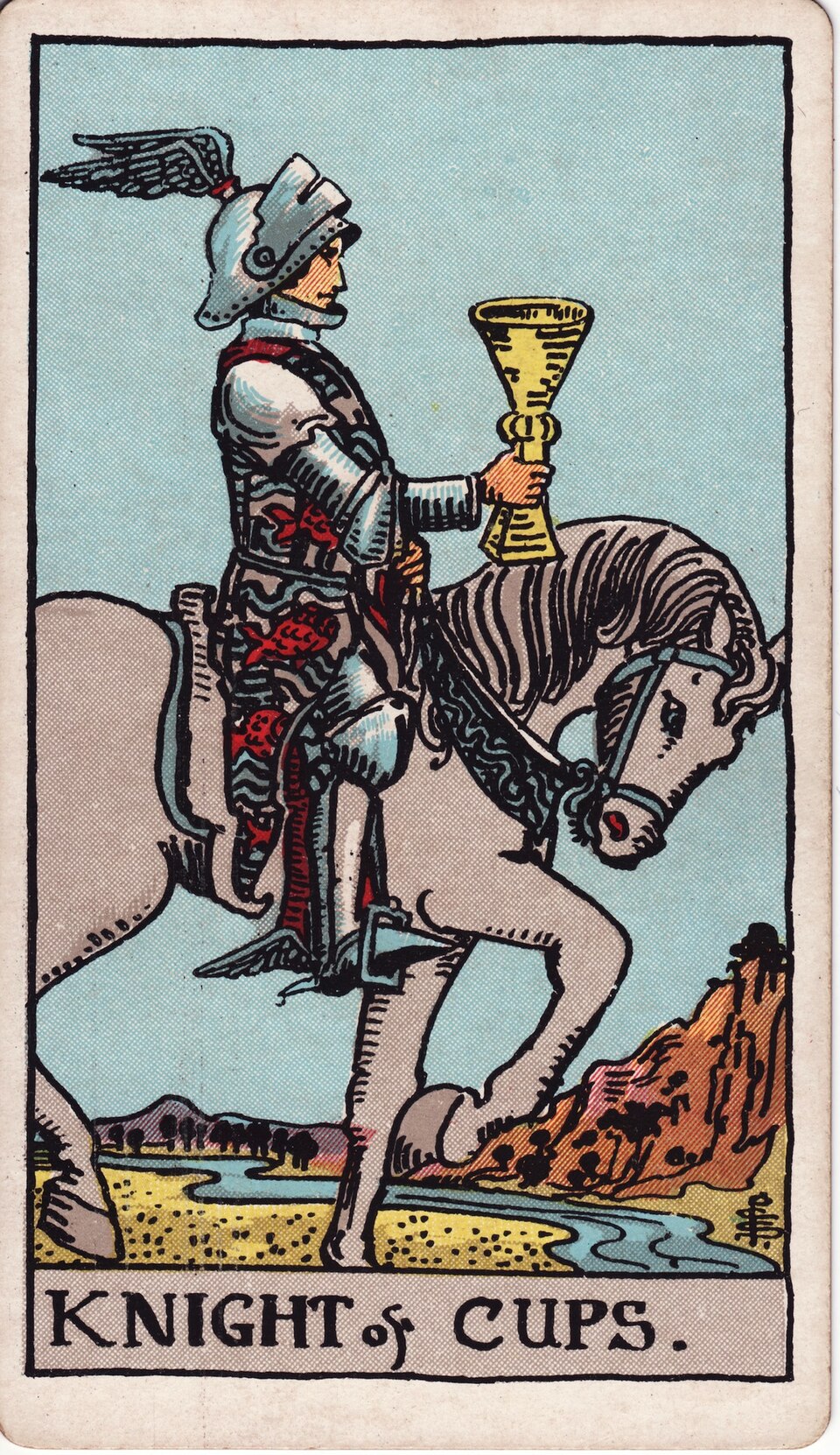
Knight of Cups
The Knight of Cups represents devotion, idealism, and the pursuit of emotional or spiritual vision. In the Rider–Waite deck, the knight advances slowly, holding a cup as an offering rather than a weapon. Where the Page of Cups listens inwardly to feeling, the Knight of Cups moves outward in response to it. Emotion becomes quest.
This card embodies the romantic and visionary aspect of the heart. Feeling is no longer exploratory; it is directed toward an ideal, whether love, beauty, meaning, or spiritual aspiration.
Esoteric Meaning
In practical interpretation, the Knight of Cups signifies:
- Idealism and romantic pursuit
- Devotion to a vision or cause
- Emotional expression
- Artistic or spiritual calling
- Invitations, proposals, or vows
At a deeper level, the Knight of Cups represents emotion animated by will. Fire moves Water, transforming feeling into action guided by imagination and longing. This card teaches that devotion has power when it is sincere; but risk when it is untethered from reality.
In its shadow aspect, the Knight of Cups can indicate escapism, emotional manipulation, or pursuit of fantasy at the expense of truth. When ideals replace discernment, disappointment follows.
The Knight of Cups in the Golden Dawn System
In the Golden Dawn system, the Knight of Cups corresponds to Fire of Water and is titled the Prince of Cups.
- Element: Fire of Water
- Realm: Tiphareth acting through Briah
- Function: Activation and pursuit of feeling
Fire within Water produces passionate emotion and visionary movement. The Prince channels feeling into symbolic action, poetry, ritual, and devotion. This is the emotional body set in motion by desire for meaning.
This is the seeker of the Grail.
Symbolism in the Rider–Waite Deck
Each symbol reinforces devotional movement:
- The Offered Cup: Emotional or spiritual offering
- The Slow Horse: Measured, reflective progress
- The River: Flow of feeling
- The Winged Helmet: Imagination and aspiration
- The Peaceful Landscape: Non-aggressive intent
The Knight advances not to conquer, but to offer and commit.
Role in the Great Work
Within the Great Work, the Knight of Cups represents the trial of devotion and idealism. After emotional sensitivity awakens, the practitioner seeks to embody feeling through action, ritual, and vow. This is the path of the mystic, artist, and lover.
The card teaches discernment in devotion. The Work advances when ideals are honored without abandoning reality.
Where the Page of Cups listens to the heart, the Knight of Cups follows it.
FAQ 1: What does the Knight of Cups represent in the Golden Dawn tradition?
In the Golden Dawn, the Knight of Cups represents Water set into motion; emotional and intuitive force actively pursuing meaning, connection, and ideal expression. It governs devotion, aspiration, and the movement of feeling toward its object.
FAQ 2: Is the Knight of Cups just a romantic or unrealistic dreamer?
No. While idealism is present, the Knight of Cups is not fantasy-bound. In Golden Dawn teaching, it represents emotion guided by vision, where feeling seeks embodiment through purpose, beauty, and sincere commitment.
FAQ 3: How do Knight cards function in the Golden Dawn court system?
In the Golden Dawn system, Knights represent active force and propulsion. They are the “Fire of the element,” showing how elemental power moves outward, engages the world, and pursues expression.
FAQ 4: What elemental forces govern the Knight of Cups?
The Knight of Cups is governed by Fire acting through Water. This combination produces passionate feeling, emotional courage, and the willingness to act in service of ideals, relationships, or spiritual calling.
FAQ 5: How does the Knight of Cups function initiatorily?
Initiatorily, the Knight of Cups teaches the initiate to follow the call of the heart with discernment. It marks the phase where emotion must be tested through action, revealing whether devotion is grounded or merely imagined.
FAQ 6: What happens when the Knight of Cups is unbalanced or misunderstood?
When unbalanced, the Knight of Cups may manifest as escapism, emotional inconsistency, or projection of ideals onto others. In Golden Dawn doctrine, imbalance occurs when feeling moves without clarity or responsibility.