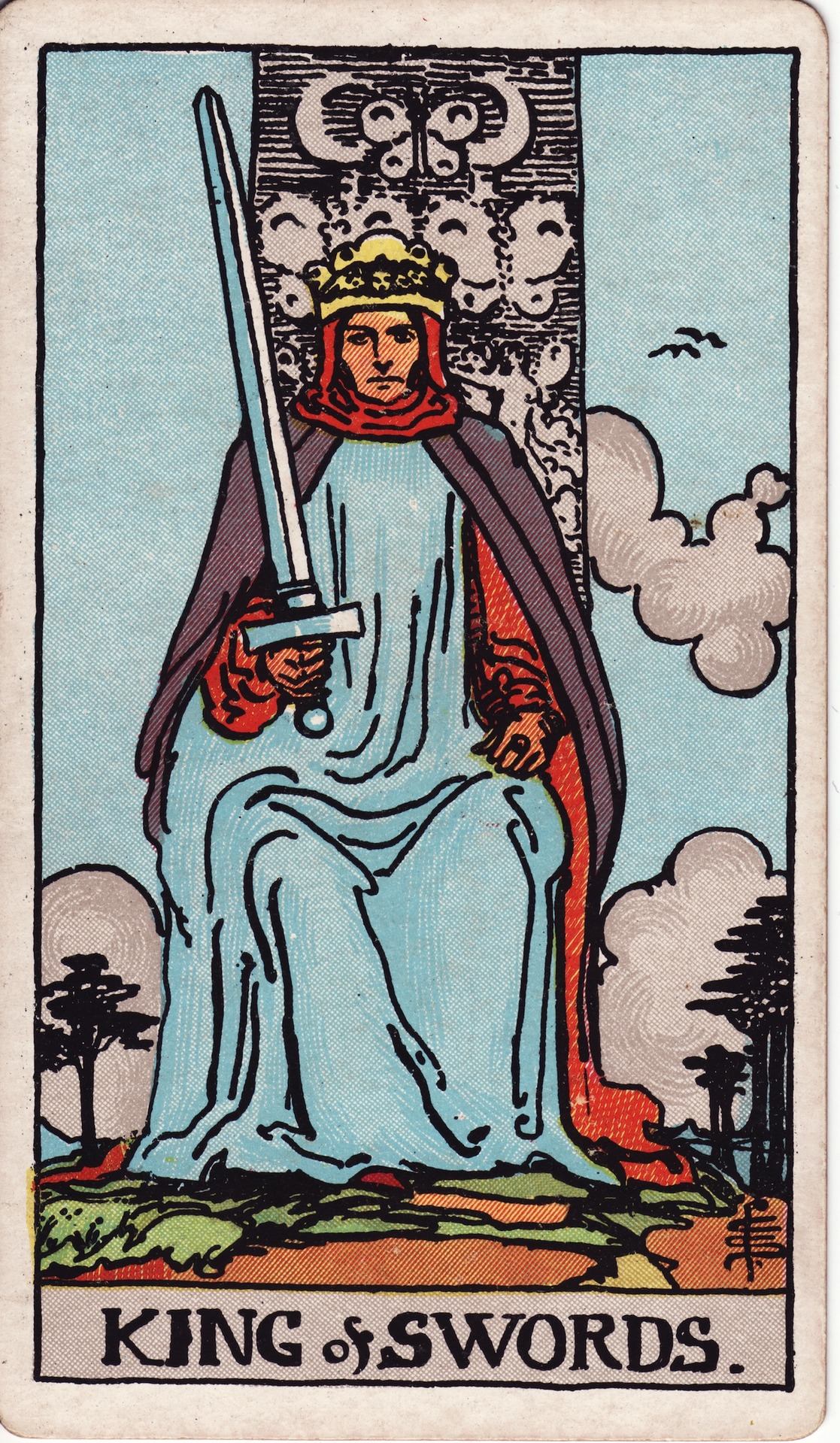
King of Swords
The King of Swords represents intellectual authority, ethical judgment, and mastery of truth through reason. In the Rider–Waite deck, he sits upon a stone throne, sword upright and steady, gaze direct and unflinching. Where the Queen of Swords refines truth through discernment and experience, the King of Swords establishes order through principle. This is intellect fully sovereign.
This card embodies thought that governs rather than reacts. Decisions are made according to law, logic, and objective truth; not emotion, impulse, or persuasion.
Esoteric Meaning
In practical interpretation, the King of Swords signifies:
- Authority through intellect
- Clear judgment and fairness
- Leadership guided by reason
- Ethical decision-making
- Mastery of communication and law
At a deeper level, the King of Swords represents the logos fully realized; mind aligned with universal order. Thought has been purified of personal bias and now serves truth itself. This is reason elevated to responsibility.
In his shadow aspect, the King of Swords can indicate tyranny of logic, emotional detachment, or cold enforcement of rules without compassion. When reason is severed from humanity, justice becomes cruelty.
The King of Swords in the Golden Dawn System
In the Golden Dawn system, the King of Swords corresponds to Air of Air and is titled the Knight of Swords.
- Element: Air of Air
- Realm: Chokmah acting through Yetzirah
- Function: Command and governance of thought
Air within Air produces pure intellect; strategy, abstraction, and law. The King of Swords governs the entire mental domain, setting boundaries, definitions, and standards by which truth is measured.
This is the mind that rules ideas rather than being ruled by them.
Symbolism in the Rider–Waite Deck
Each symbol reinforces intellectual sovereignty:
- The Upright Sword: Authority of truth and law
- The Stone Throne: Stability and permanence
- The Butterflies: Transformation through understanding
- The Clear Sky: Unobstructed reason
- The Direct Gaze: Accountability and judgment
The King does not argue—he decides.
Role in the Great Work
Within the Great Work, the King of Swords represents the completion of mental mastery. The practitioner has learned curiosity, force, restraint, and discernment, and now governs thought with clarity and responsibility. The mind is no longer reactive; it is authoritative.
This card teaches that truth carries obligation. To see clearly is to act justly. Intellectual mastery is measured not by cleverness, but by the capacity to uphold order without losing humanity.
Where the Queen of Swords refines truth, the King of Swords establishes it as law.
FAQ 1: What does the King of Swords represent in the Golden Dawn tradition?
In the Golden Dawn, the King of Swords represents Air in its state of external rulership; intellectual mastery expressed through authority, judgment, and the power to govern through reason. He governs law, truth articulated as structure, and command exercised through clarity of mind.
FAQ 2: Is the King of Swords cold, ruthless, or authoritarian?
No. While the King of Swords values truth over emotion, he is not inherently cruel. In Golden Dawn teaching, he represents ethical authority, where judgment is guided by principle, fairness, and intellectual integrity rather than personal bias.
FAQ 3: How do King cards function in the Golden Dawn court system?
In the Golden Dawn system, Kings represent external authority and directive governance. They are the “air of the element,” showing how elemental power is organized, legislated, and enforced in the outer world.
FAQ 4: What elemental forces govern the King of Swords?
The King of Swords is governed by Air acting through Air, producing pure intellectual sovereignty. This manifests as command of language, systems of law, ethical reasoning, and the ability to establish order through thought.
FAQ 5: How does the King of Swords function initiatorily?
Initiatorily, the King of Swords teaches the initiate responsibility of truth. He marks the stage where knowledge must be wielded with accountability, ensuring that clarity serves justice and order rather than domination.
FAQ 6: What happens when the King of Swords is unbalanced or misunderstood?
When unbalanced, the King of Swords may manifest as dogmatism, intellectual tyranny, or detachment from human consequence. In Golden Dawn doctrine, imbalance occurs when reason becomes disconnected from wisdom and compassion.