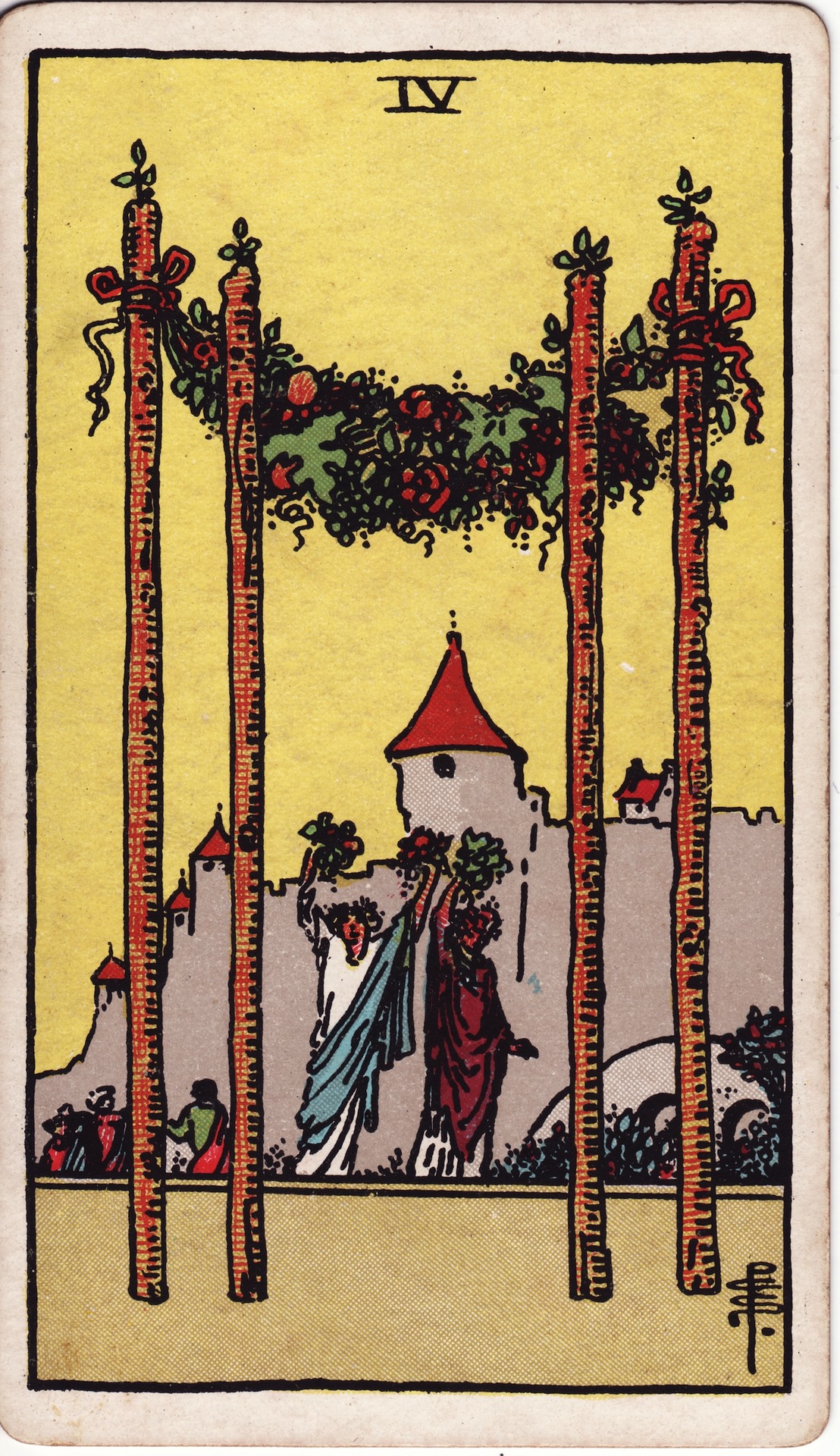
Four of Wands
The Four of Wands represents stability, completion, and the establishment of a secure foundation. In the Rider–Waite deck, a garlanded structure stands as figures celebrate beneath it, marking a moment of arrival and harmony. Where the Three of Wands projects creative force outward, the Four of Wands shows that force successfully anchored. The work has taken form and can now be inhabited.
This card marks a pause of affirmation. Effort has produced structure, and that structure supports community, joy, and continuity.
Esoteric Meaning
In practical interpretation, the Four of Wands signifies:
- Stability and security
- Completion of a phase
- Celebration and harmony
- Foundation and home
- Successful collaboration
At a deeper level, the Four of Wands represents fire brought into balance. Creative force has been stabilized into form without losing vitality. This card teaches that true success includes rest, recognition, and shared enjoyment—not endless expansion.
In its shadow aspect, the Four of Wands can indicate complacency, stagnation, or fear of moving beyond comfort. When stability becomes fixation, growth halts.
The Four of Wands on the Tree of Life
In the Golden Dawn system, the Four of Wands is attributed to Chesed in Atziluth.
Chesed represents order, harmony, and benevolent structure. When expressed through Fire, it produces creative stability and harmonious power. The Four of Wands reflects will that has been organized into a sustainable form.
This is fire that supports rather than consumes.
Symbolism in the Rider–Waite Deck
Each symbol reinforces completion and stability:
- The Garlanded Structure: Achievement and foundation
- The Upright Wands: Balanced creative pillars
- The Celebrating Figures: Communal harmony
- The Open Space: Freedom within structure
- The Castle in the Distance: Security and continuity
The Four of Wands teaches that success is meant to be lived and shared.
Role in the Great Work
Within the Great Work, the Four of Wands represents the first stable embodiment of will. After expansion and projection, the practitioner arrives at a place that can be occupied; physically, emotionally, or spiritually. This is a moment of grounding.
The card teaches that celebration is not distraction, but confirmation. Recognizing completion strengthens the Work rather than weakening it.
Where the Three of Wands extends power outward, the Four of Wands establishes a home for it.
FAQ 1: What does the Four of Wands represent in the Golden Dawn tradition?
In the Golden Dawn, the Four of Wands represents the stabilization of Fire; the consolidation of will into secure structure and established power. It governs order, authority, and the successful grounding of creative force.
FAQ 2: Is the Four of Wands just about celebration or social events?
No. While celebration may accompany it, the Four of Wands is not primarily about festivities. In Golden Dawn teaching, it represents the successful establishment of power, where will has been organized into a stable and functional form.
FAQ 3: How is the Four of Wands related to the Tree of Life?
The Four of Wands corresponds to Chesed in the world of Atziluth. Chesed represents stability and benevolent authority; in Atziluth, this manifests as structured will, lawful dominion, and ordered creative power.
FAQ 4: What elemental force governs the Four of Wands?
The Four of Wands is governed by the element of Fire. Here, Fire expresses itself as controlled energy, leadership, and the capacity to sustain creative authority over time.
FAQ 5: How does the Four of Wands function initiatorily?
Initiatorily, the Four of Wands marks the point where will becomes secure. The initiate learns to hold power responsibly, maintaining structure without suppressing vitality or growth.
FAQ 6: What happens when the Four of Wands is unbalanced or misunderstood?
When unbalanced, the Four of Wands may manifest as rigidity, authoritarianism, or stagnation. In Golden Dawn doctrine, imbalance occurs when order becomes inflexible and authority resists necessary change.