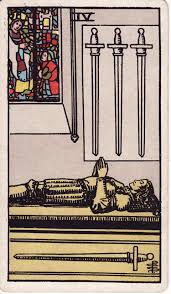
Four of Swords
The Four of Swords represents rest, recovery, and withdrawal after mental conflict. In the Rider–Waite deck, a figure lies in repose within a chapel, hands folded, swords suspended above in stillness. Where the Three of Swords exposes painful truth through rupture, the Four of Swords offers cessation and sanctuary. Conflict pauses so that healing may occur.
This card marks a necessary interval. The mind, having been strained by sorrow and division, must now withdraw from engagement to regain clarity and equilibrium.
Esoteric Meaning
In practical interpretation, the Four of Swords signifies:
- Rest and recuperation
- Mental withdrawal
- Reflection and solitude
- Temporary disengagement
- Recovery after conflict
At a deeper level, the Four of Swords represents silence as medicine. It teaches that insight cannot be integrated while the mind remains in constant motion. Stillness becomes the condition for synthesis.
In its shadow aspect, the Four of Swords can indicate avoidance, stagnation, or refusal to re-engage with life. When rest becomes escape, healing is delayed.
The Four of Swords on the Tree of Life
In the Golden Dawn system, the Four of Swords is attributed to Chesed in Yetzirah.
Chesed represents mercy, order, and stabilization. When expressed through Air, it produces mental calm and structured repose. The Four of Swords is the benevolent restraint that prevents further damage after turmoil.
This is mercy applied to the intellect.
Symbolism in the Rider–Waite Deck
Each symbol reinforces withdrawal and restoration:
- The Reclining Figure: Voluntary rest
- The Chapel: Sanctuary and protection
- The Three Suspended Swords: Conflict held in abeyance
- The Fourth Sword Below: Stability through grounding
- The Stained Glass: Higher meaning preserved during rest
The Four of Swords teaches that peace sometimes requires stepping away.
Role in the Great Work
Within the Great Work, the Four of Swords represents the integration phase after mental pain. Having confronted sorrow and truth, the practitioner must now allow insight to settle. This is not regression, but preparation.
The card teaches that endurance includes knowing when to pause. Without rest, clarity fractures again into conflict.
Where the Three of Swords wounds through truth, the Four of Swords heals through stillness.
FAQ 1: What does the Four of Swords represent in the Golden Dawn tradition?
In the Golden Dawn, the Four of Swords represents the stabilization of Air; the consolidation of mental force into order, stillness, and controlled thought. It governs rest not as inactivity, but as deliberate mental preservation.
FAQ 2: Is the Four of Swords just about rest or taking a break?
No. While rest is involved, the Four of Swords is not merely about recovery from exhaustion. In Golden Dawn teaching, it represents the containment and regulation of the mind, allowing clarity and structure to be maintained without overextension.
FAQ 3: How is the Four of Swords related to the Tree of Life?
The Four of Swords corresponds to Chesed in the world of Yetzirah. Chesed provides order and stability; in Yetzirah, this manifests as mental discipline, calm reasoning, and the preservation of intellectual coherence.
FAQ 4: What elemental force governs the Four of Swords?
The Four of Swords is governed by the element of Air. Here, Air expresses itself as controlled thought, mental boundaries, and the capacity to maintain clarity through stillness rather than constant analysis.
FAQ 5: How does the Four of Swords function initiatorily?
Initiatorily, the Four of Swords teaches strategic withdrawal. The initiate learns that sustained clarity requires periods of mental quiet, where insight is preserved and refined rather than continually expended.
FAQ 6: What happens when the Four of Swords is unbalanced or misunderstood?
When unbalanced, the Four of Swords may manifest as withdrawal, stagnation, or avoidance of engagement. In Golden Dawn doctrine, imbalance occurs when rest becomes isolation and order becomes rigidity.