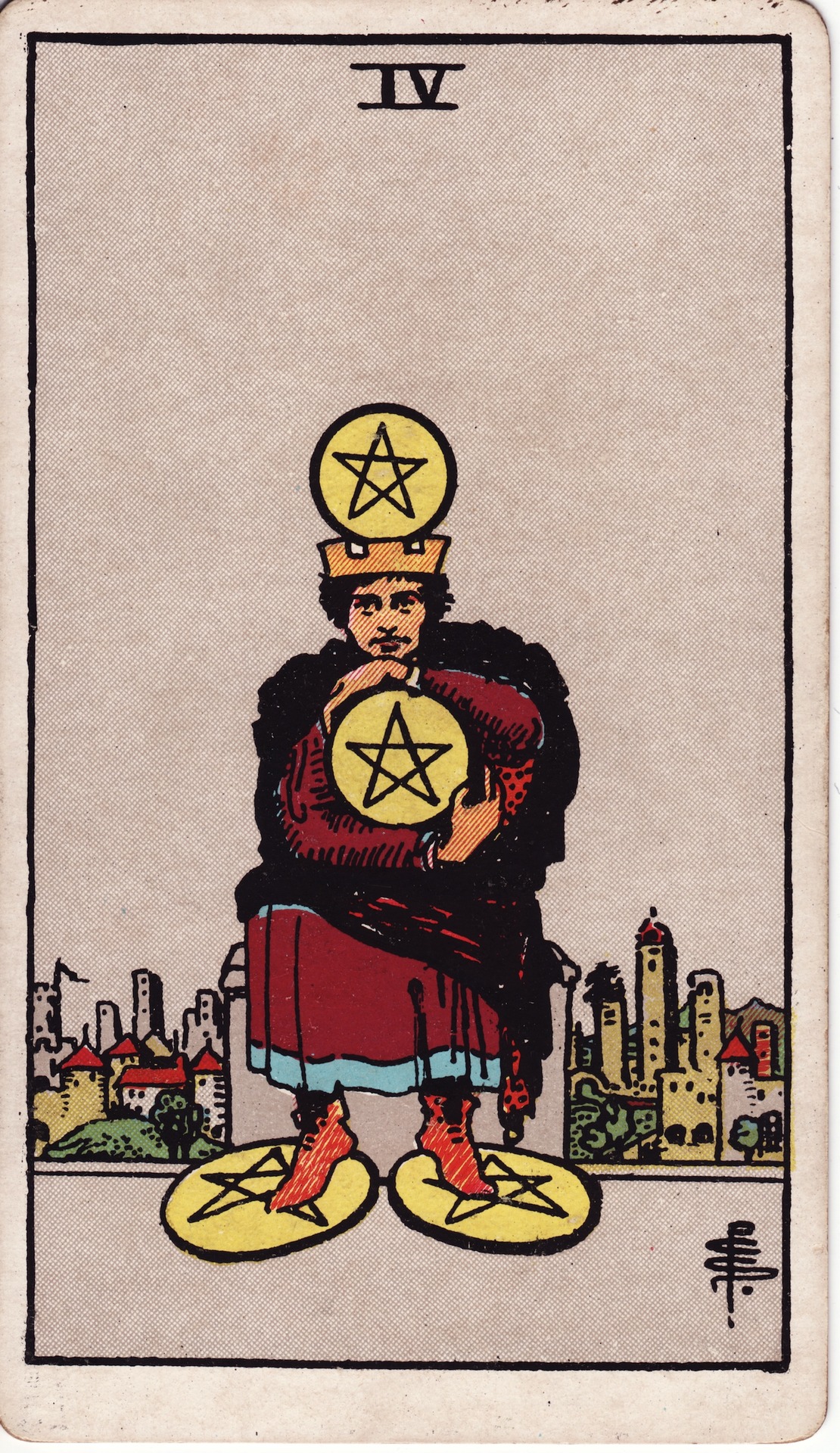
Four of Pentacles
The Four of Pentacles represents consolidation, control, and the stabilization of material resources. In the Rider–Waite deck, a crowned figure sits firmly holding a pentacle to his chest, with additional pentacles placed beneath his feet and above his head. Where the Three of Pentacles builds structure through collaboration, the Four of Pentacles marks the point where structure is secured and held.
This card reflects the moment when material success is no longer being built, but protected. Stability has been achieved—but at the cost of movement.
Esoteric Meaning
In practical interpretation, the Four of Pentacles signifies:
- Stability and security
- Possession and control
- Conservation of resources
- Boundaries and protection
- Fear of loss
At a deeper level, the Four of Pentacles represents identification with form. It is the instinct to preserve what has been gained, sometimes to the point of rigidity. This card teaches that while consolidation is necessary, attachment can quietly become limitation.
In its shadow aspect, the Four of Pentacles manifests as greed, stagnation, or fear-driven control. When holding replaces flow, energy ceases to circulate.
The Four of Pentacles on the Tree of Life
In the Golden Dawn system, the Four of Pentacles is attributed to Chesed in Assiah.
Chesed represents order, authority, and expansion through structure. In Earth, this produces material stability and ownership. The Four of Pentacles expresses the establishment of power through accumulation and control.
However, Chesed’s expansive nature becomes constrained when expressed too rigidly in matter.
Symbolism in the Rider–Waite Deck
Each symbol emphasizes holding and fixation:
- The Crowned Figure: Authority derived from possession
- Pentacle on the Chest: Emotional attachment to material security
- Pentacles Under the Feet: Grounding through control
- Pentacle Above the Head: Identity bound to material success
- The Walled City: Security through separation
The Four of Pentacles teaches that stability must not become entrapment.
Role in the Great Work
Within the Great Work, the Four of Pentacles represents the test of attachment. After establishing skill and structure, the practitioner must decide whether to cling to what has been built or allow it to circulate and evolve.
The card warns that the Work can stall when identity becomes tied to outcome. Security is necessary; but transformation requires release.
Where the Three of Pentacles builds value, the Four of Pentacles asks whether that value is possessed or served.
FAQ 1: What does the Four of Pentacles represent in the Golden Dawn tradition?
In the Golden Dawn, the Four of Pentacles represents the stabilization of Earth; the consolidation of material force into defined structure and control. It governs preservation, boundaries, and the maintenance of form once manifestation has been established.
FAQ 2: Is the Four of Pentacles about greed or possessiveness?
No. While greed may appear when the card is distorted, the Four of Pentacles is not inherently negative. In Golden Dawn teaching, it represents containment and security, the necessary holding of material force to prevent dissipation.
FAQ 3: How is the Four of Pentacles related to the Tree of Life?
The Four of Pentacles corresponds to Chesed in the world of Assiah. Chesed represents stability, order, and authority; in Assiah, this manifests as material structure, ownership, and the maintenance of physical boundaries.
FAQ 4: What elemental force governs the Four of Pentacles?
The Four of Pentacles is governed by the element of Earth. Earth here expresses itself as solidity, endurance, and the ability to hold form steadily over time.
FAQ 5: How does the Four of Pentacles function initiatorily?
Initiatorily, the Four of Pentacles teaches responsible stewardship. The initiate learns how to preserve what has been created, recognizing that stability is required before growth or expansion can occur.
FAQ 6: What happens when the Four of Pentacles is unbalanced or misunderstood?
When unbalanced, the Four of Pentacles may manifest as rigidity, fear of loss, or excessive control. In Golden Dawn doctrine, imbalance occurs when preservation becomes attachment and security replaces trust in the flow of the Work.