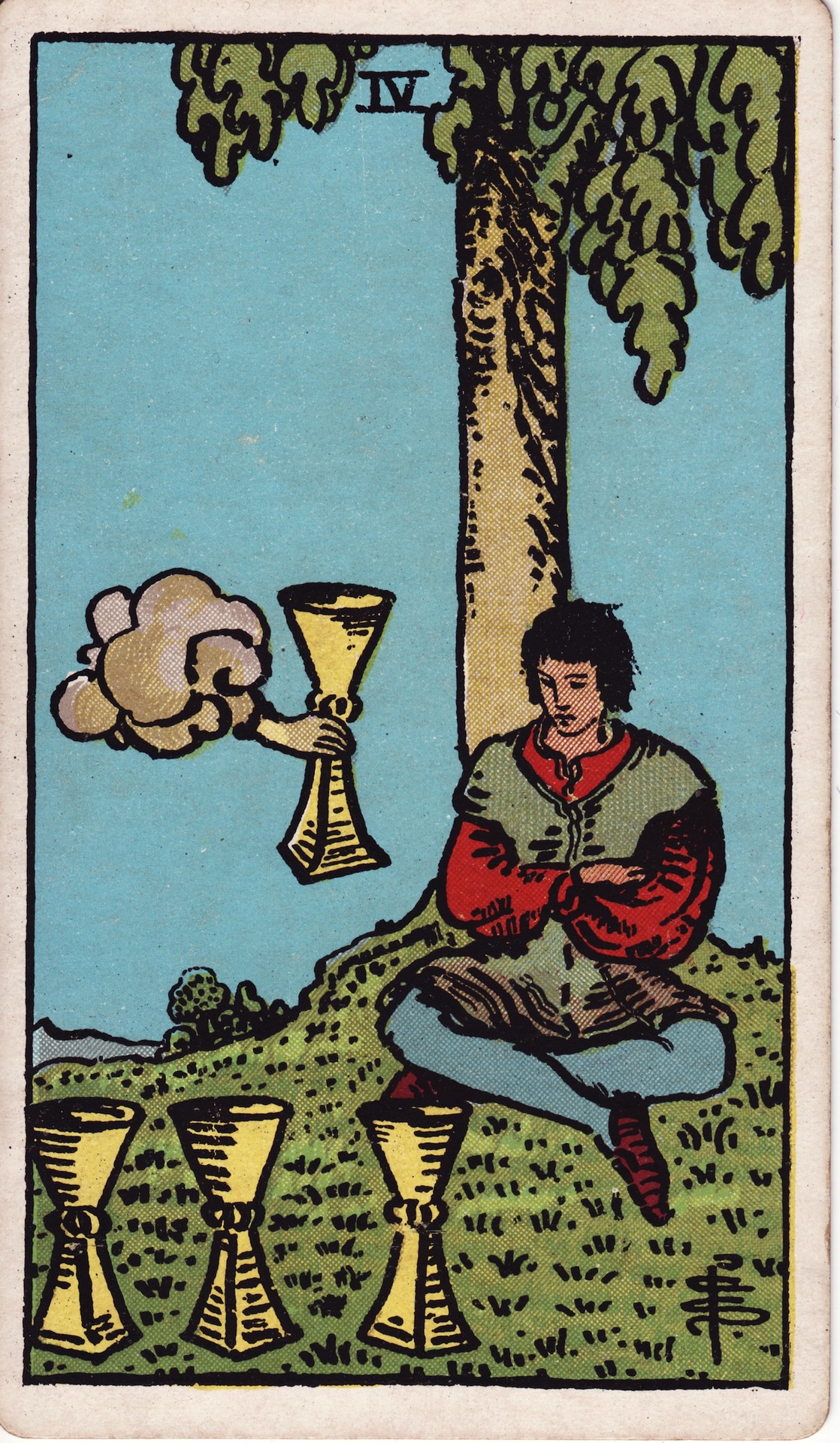
Four of Cups
The Four of Cups represents withdrawal, introspection, and emotional stagnation born of complacency. In the Rider–Waite deck, a seated figure gazes downward at three cups before him, seemingly indifferent as a fourth cup is offered from a cloud. Where the Three of Cups celebrates shared joy and abundance, the Four of Cups depicts the moment when satisfaction dulls awareness. Feeling turns inward and disengaged.
This card marks a pause in emotional flow. Pleasure has blended into routine, and opportunity is present; but unnoticed.
Esoteric Meaning
In practical interpretation, the Four of Cups signifies:
- Emotional withdrawal
- Discontent or boredom
- Apathy toward opportunity
- Introspection and reassessment
- Emotional saturation
At a deeper level, the Four of Cups represents feeling turned static. Water settles and becomes heavy when it no longer circulates. This card teaches that emotional fulfillment requires renewal; without movement, even joy becomes inert.
In its shadow aspect, the Four of Cups can indicate emotional avoidance, ingratitude, or refusal to engage with life. When introspection becomes isolation, the heart closes to grace.
The Four of Cups on the Tree of Life
In the Golden Dawn system, the Four of Cups is attributed to Chesed in Briah.
Chesed represents stability, mercy, and structure. When expressed through Water, it produces emotional equilibrium that can slip into complacency. The Four of Cups reflects feeling stabilized to the point of inertia.
This is contentment that risks becoming disengagement.
Symbolism in the Rider–Waite Deck
Each symbol reinforces emotional pause and inward focus:
- The Seated Figure: Withdrawal and contemplation
- The Three Cups: Familiar emotional patterns
- The Offered Cup: Unrecognized opportunity
- The Clouded Hand: Divine invitation
- The Grounded Posture: Emotional heaviness
The Four of Cups teaches that opportunity is often missed not from lack, but from saturation.
Role in the Great Work
Within the Great Work, the Four of Cups represents the trial of spiritual complacency. After joy and communion, the practitioner may lose sensitivity to subtle invitation. The Work stalls not through suffering, but through emotional dullness.
The lesson here is awareness. Renewal arrives when the heart reopens to grace rather than clinging to familiarity.
Where the Three of Cups celebrates abundance, the Four of Cups questions whether it is still alive.
FAQ 1: What does the Four of Cups represent in the Golden Dawn tradition?
In the Golden Dawn, the Four of Cups represents the stabilization of Water; the containment of emotional and intuitive force into a settled inner state. It governs emotional equilibrium, introspection, and the preservation of feeling without outward expression.
FAQ 2: Is the Four of Cups about boredom or emotional apathy?
No. While apathy may appear when the card is distorted, the Four of Cups is not fundamentally about boredom. In Golden Dawn teaching, it represents emotional consolidation, where feeling is held inwardly to prevent dissipation or excess.
FAQ 3: How is the Four of Cups related to the Tree of Life?
The Four of Cups corresponds to Chesed in the world of Briah. Chesed represents stability and order; in Briah, this manifests as emotional regulation, inner balance, and sustained intuitive awareness.
FAQ 4: What elemental force governs the Four of Cups?
The Four of Cups is governed by the element of Water. Here, Water expresses itself as containment, emotional depth, and the capacity to maintain inner harmony without constant external stimulation.
FAQ 5: How does the Four of Cups function initiatorily?
Initiatorily, the Four of Cups teaches emotional self-sufficiency. The initiate learns to stabilize inner feeling, developing the ability to hold emotional awareness without dependence on external validation or excitement.
FAQ 6: What happens when the Four of Cups is unbalanced or misunderstood?
When unbalanced, the Four of Cups may manifest as emotional withdrawal, stagnation, or indifference. In Golden Dawn doctrine, imbalance occurs when containment becomes isolation and inner equilibrium turns into disengagement.