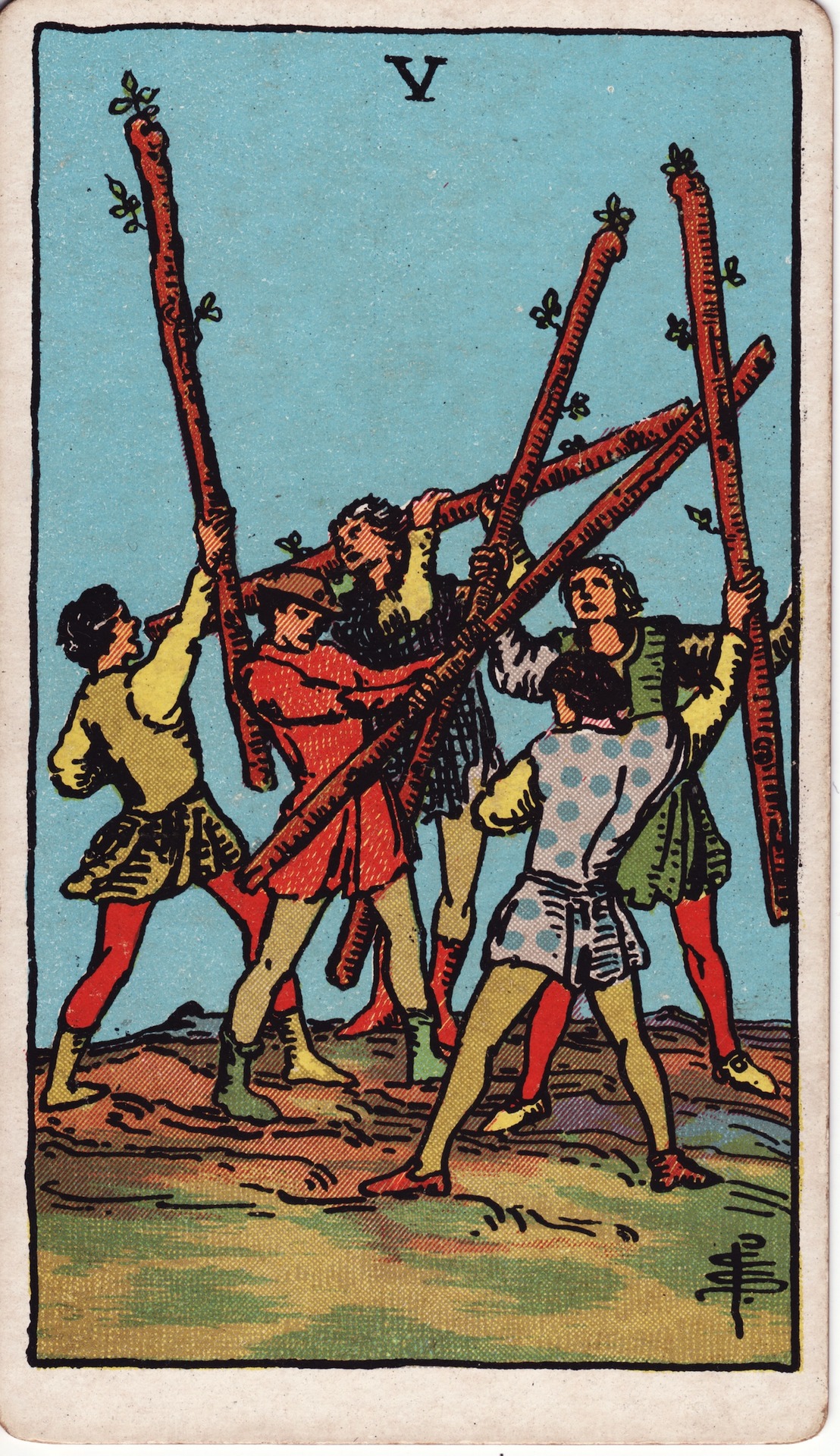
Five of Wands
The Five of Wands represents conflict, competition, and the fragmentation of creative force. In the Rider–Waite deck, figures clash with staves in apparent disorder, none clearly dominating. Where the Four of Wands stabilizes and celebrates harmony, the Five of Wands introduces discord born of multiple wills. Fire multiplies; and in doing so, collides.
This card marks the point where creative energy becomes contested. Purpose is present, but coordination is absent. Momentum exists, yet direction fractures into rivalry.
Esoteric Meaning
In practical interpretation, the Five of Wands signifies:
- Conflict and competition
- Creative tension
- Disagreement and rivalry
- Testing of strength
- Chaos without clear outcome
At a deeper level, the Five of Wands represents unintegrated will. Fire seeks expression through many channels at once, producing friction rather than progress. This card teaches that raw energy without hierarchy or synthesis devolves into struggle.
In its shadow aspect, the Five of Wands can indicate ego clashes, wasted effort, or perpetual argument. When conflict becomes identity, creativity exhausts itself.
The Five of Wands on the Tree of Life
In the Golden Dawn system, the Five of Wands is attributed to Geburah in Atziluth.
Geburah represents severity, force, and corrective tension. When expressed through Fire, it produces combative energy and creative stress. The Five of Wands reflects the necessary friction that tests strength—but also the danger of uncontrolled force.
This is will sharpening itself through resistance.
Symbolism in the Rider–Waite Deck
Each symbol reinforces chaotic competition:
- The Five Staves: Multiple competing wills
- The Disordered Clash: Lack of coordination
- The Equal Standing Figures: No clear authority
- The Open Space: Conflict without structure
- The Youthful Energy: Passion without discipline
The Five of Wands teaches that not all conflict is destructive; but it must be resolved or refined.
Role in the Great Work
Within the Great Work, the Five of Wands represents the trial of creative conflict. After establishing stability, the practitioner encounters competing impulses; internal or external; that challenge unity of purpose. This is the test of leadership and synthesis.
The card teaches discernment: conflict can strengthen the Work when ordered, or fracture it when indulged. Fire must be governed, not multiplied without control.
Where the Four of Wands stabilizes fire, the Five of Wands tests its cohesion.
FAQ 1: What does the Five of Wands represent in the Golden Dawn tradition?
In the Golden Dawn, the Five of Wands represents the disruption of Fire; creative force subjected to severity and fragmentation. It governs conflict, friction, and the clash of competing wills without unified direction.
FAQ 2: Is the Five of Wands just about friendly competition or playfulness?
No. While competition may appear externally, the Five of Wands is not harmless or lighthearted. In Golden Dawn teaching, it represents uncoordinated force, where energy is expended chaotically rather than directed toward a single purpose.
FAQ 3: How is the Five of Wands related to the Tree of Life?
The Five of Wands corresponds to Geburah in the world of Atziluth. Geburah introduces severity; in Atziluth, this manifests as the breaking of unified will into conflicting expressions of power.
FAQ 4: What elemental force governs the Five of Wands?
The Five of Wands is governed by the element of Fire. Here, Fire expresses itself as raw energy and drive, but without harmony, producing agitation, rivalry, and internal opposition.
FAQ 5: How does the Five of Wands function initiatorily?
Initiatorily, the Five of Wands teaches the necessity of discipline. The initiate learns that power without coordination leads to exhaustion and conflict, and that true strength requires alignment and hierarchy of purpose.
FAQ 6: What happens when the Five of Wands is unbalanced or misunderstood?
When unbalanced, the Five of Wands may manifest as constant struggle, aggression, or wasted effort. In Golden Dawn doctrine, imbalance occurs when severity fragments will instead of refining it into coherent authority.