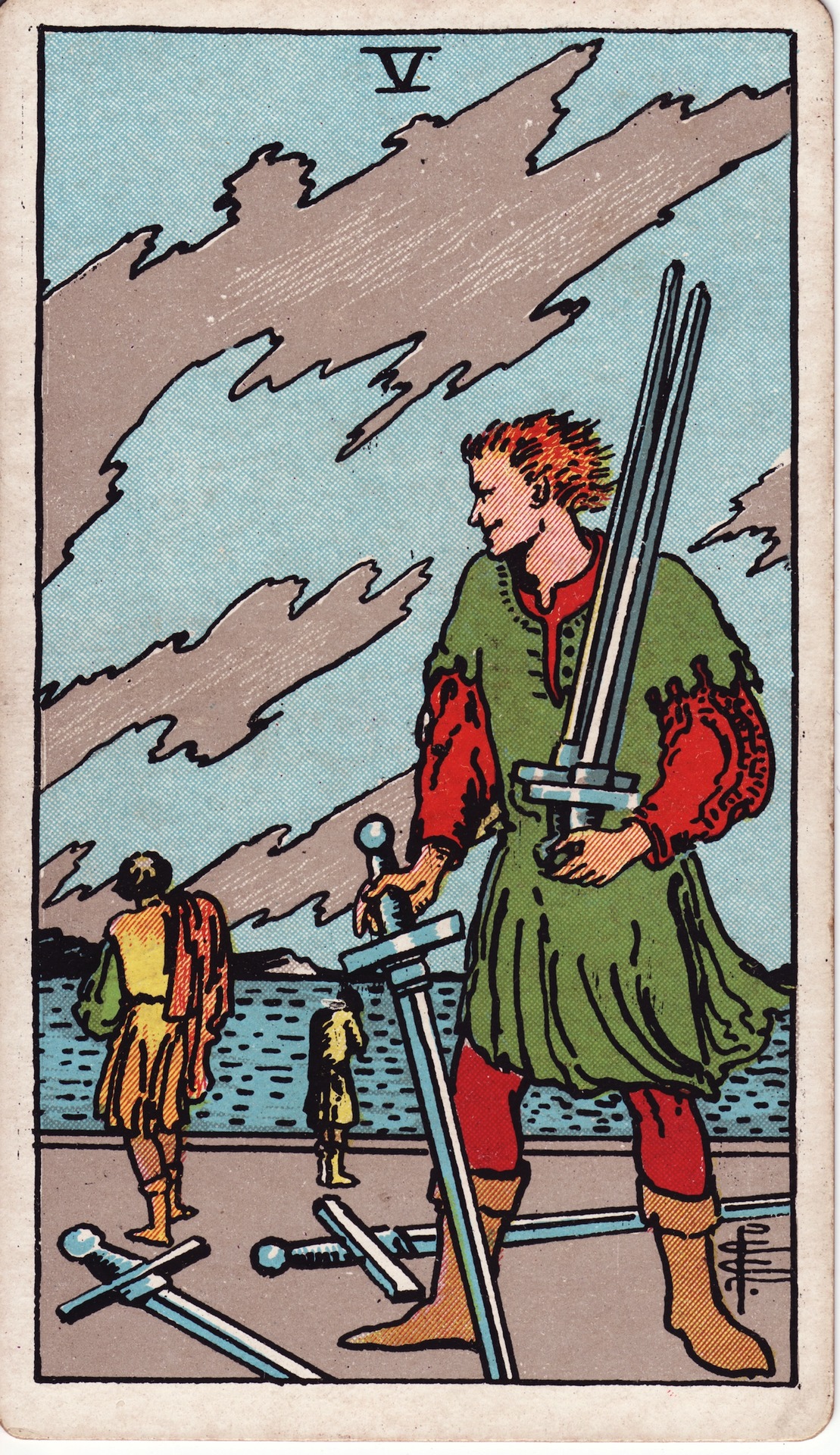
Five of Swords
The Five of Swords represents conflict, hollow victory, and the ethical cost of domination. In the Rider–Waite deck, a figure gathers swords from fallen opponents while others walk away in defeat. Where the Four of Swords withdraws to heal, the Five of Swords depicts a return to engagement; but one marked by imbalance and loss of honor. Someone has “won,” yet something essential has been forfeited.
This card marks the moment when intellect is used to overpower rather than to understand. Victory is achieved, but at the expense of relationship, integrity, or long-term harmony.
Esoteric Meaning
In practical interpretation, the Five of Swords signifies:
- Conflict and confrontation
- Pyrrhic victory
- Power struggles
- Betrayal or unethical tactics
- Winning at a cost
At a deeper level, the Five of Swords represents the corruption of intellect by ego. Thought becomes a weapon rather than a tool of clarity. The card teaches that domination through reason ultimately isolates the victor and destabilizes the system it seeks to control.
In its shadow aspect, the Five of Swords can indicate cruelty, manipulation, or fixation on being right rather than being true. When intellect serves pride, understanding collapses.
The Five of Swords on the Tree of Life
In the Golden Dawn system, the Five of Swords is attributed to Geburah in Yetzirah.
Geburah represents severity, conflict, and correction. When expressed through Air, it produces mental aggression and destructive argument. The Five of Swords reflects the breaking force of intellect unchecked by compassion or balance.
This is severity acting without wisdom.
Symbolism in the Rider–Waite Deck
Each symbol reinforces moral imbalance:
- The Victorious Figure: Ego-centered triumph
- The Collected Swords: Power seized rather than earned
- The Retreating Figures: Loss, resentment, and alienation
- The Wind-Swept Sky: Turbulence and instability
- The Shoreline: Emotional fallout of conflict
The Five of Swords teaches that victory without integrity is defeat in disguise.
Role in the Great Work
Within the Great Work, the Five of Swords represents the temptation to misuse clarity. After gaining insight and recovering strength, the practitioner may attempt to impose understanding rather than embody it. This card warns against using truth as a means of domination.
The lesson here is ethical discernment. Not every battle should be fought, and not every victory advances the Work.
Where the Four of Swords restores balance through rest, the Five of Swords tests whether balance is honored or abandoned.
FAQ 1: What does the Five of Swords represent in the Golden Dawn tradition?
In the Golden Dawn, the Five of Swords represents the disruption of Air; intellect under severity. It governs conflict, division, and the painful consequences of misused reason or uncompromising thought.
FAQ 2: Is the Five of Swords about winning or defeating others?
No. While victory may appear superficially, the Five of Swords is not true triumph. In Golden Dawn teaching, it represents hollow victory, where success is achieved at the cost of harmony, integrity, or understanding.
FAQ 3: How is the Five of Swords related to the Tree of Life?
The Five of Swords corresponds to Geburah in the world of Yetzirah. Geburah applies severity; in Yetzirah, this manifests as sharp division of thought, conflict of ideas, and the breakdown of intellectual unity.
FAQ 4: What elemental force governs the Five of Swords?
The Five of Swords is governed by the element of Air. Here, Air expresses itself as cutting intellect; analysis turned against cohesion, producing fragmentation and mental strife.
FAQ 5: How does the Five of Swords function initiatorily?
Initiatorily, the Five of Swords teaches responsibility in the use of intellect. The initiate learns that truth wielded without compassion becomes destructive, and that clarity must serve unity rather than ego.
FAQ 6: What happens when the Five of Swords is unbalanced or misunderstood?
When unbalanced, the Five of Swords may manifest as cruelty, manipulation, or perpetual conflict. In Golden Dawn doctrine, imbalance occurs when severity dominates wisdom and division replaces discernment.