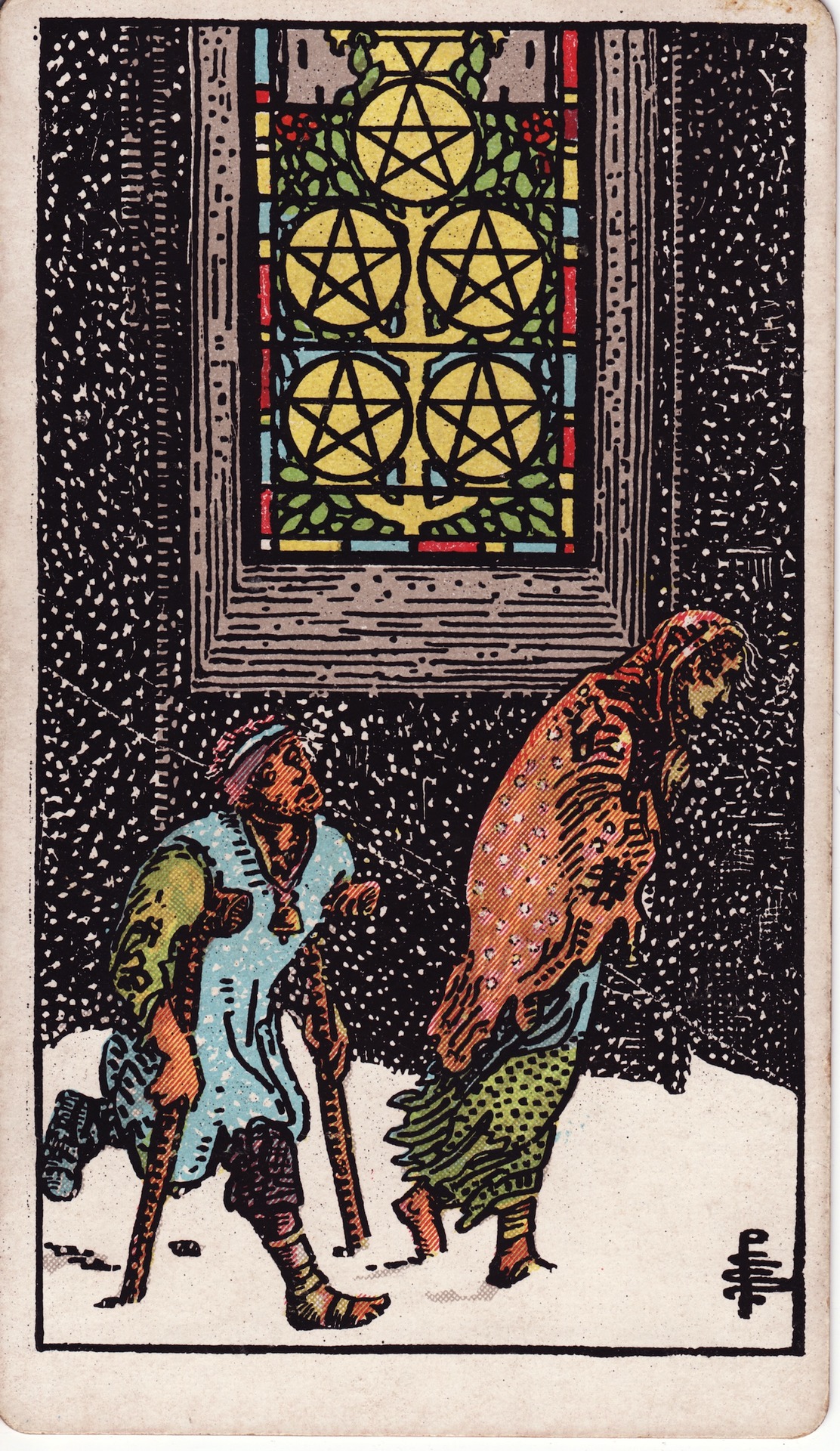
Five of Pentacles
The Five of Pentacles represents loss, hardship, and the destabilization of material security. In the Rider–Waite deck, two figures walk through snow beneath a stained-glass window, wounded, impoverished, and exposed. Where the Four of Pentacles clings to stability through control, the Five of Pentacles depicts what occurs when that stability fails or is withdrawn. What was held tightly is now absent.
This card marks the point where material identity fractures. Security is no longer guaranteed, and the illusion of permanence collapses under external pressure.
Esoteric Meaning
In practical interpretation, the Five of Pentacles signifies:
- Material loss or hardship
- Poverty or insecurity
- Exclusion and isolation
- Illness or physical depletion
- Fear rooted in scarcity
At a deeper level, the Five of Pentacles represents initiation through deprivation. It teaches that attachment to material form inevitably leads to suffering when form changes. This card strips away false security, forcing the practitioner to confront reliance on outer stability rather than inner alignment.
In its shadow aspect, the Five of Pentacles can indicate despair, victimhood, or refusal to recognize available support. When hardship is interpreted as abandonment rather than correction, suffering deepens.
The Five of Pentacles on the Tree of Life
In the Golden Dawn system, the Five of Pentacles is attributed to Geburah in Assiah.
Geburah represents severity, correction, and necessary destruction. When expressed through Earth, it produces material disruption; loss that serves as recalibration. The Five of Pentacles is not punishment, but enforcement of balance where excess attachment has formed.
This card reflects the harsh but purifying function of Geburah acting upon material conditions.
Symbolism in the Rider–Waite Deck
Each symbol reinforces deprivation and testing:
- The Snow: Cold reality and emotional isolation
- The Injured Figures: Vulnerability and exhaustion
- The Stained Glass Window: Spiritual support nearby but unrecognized
- The Crutches: Dependence and fragility
- The Darkness: Loss of orientation
The Five of Pentacles teaches that hardship often includes unseen refuge.
Role in the Great Work
Within the Great Work, the Five of Pentacles represents the breaking of material identification. After clinging to form and security, the practitioner is stripped of external assurance. This is the lesson of humility; recognizing that the Work does not depend on possession, status, or comfort.
The card teaches that loss can redirect awareness toward deeper sources of stability. What appears as failure is often correction.
Where the Four of Pentacles clings to matter, the Five of Pentacles reveals its impermanence.
FAQ 1: What does the Five of Pentacles represent in the Golden Dawn tradition?
In the Golden Dawn, the Five of Pentacles represents the disruption of Earth; material form placed under strain and severity. It governs loss of stability, material insecurity, and the breaking of comfort so that deeper values may be revealed.
FAQ 2: Is the Five of Pentacles only about poverty or financial loss?
No. While material hardship may appear externally, the Five of Pentacles is not limited to money. In Golden Dawn teaching, it represents alienation from material support, where dependence on form is exposed as insufficient.
FAQ 3: How is the Five of Pentacles related to the Tree of Life?
The Five of Pentacles corresponds to Geburah in the world of Assiah. Geburah represents severity and correction; in Assiah, this manifests as material restriction, scarcity, and the collapse of false security.
FAQ 4: What elemental force governs the Five of Pentacles?
The Five of Pentacles is governed by the element of Earth. Here, Earth expresses itself through deprivation, contraction, and the testing of endurance when physical structures fail to provide comfort.
FAQ 5: How does the Five of Pentacles function initiatorily?
Initiatorily, the Five of Pentacles teaches detachment from material dependence. The initiate learns that stability rooted solely in external form is fragile, and true grounding must arise from inner alignment rather than possession.
FAQ 6: What happens when the Five of Pentacles is unbalanced or misunderstood?
When unbalanced, the Five of Pentacles may manifest as despair, victimhood, or resentment. In Golden Dawn doctrine, imbalance occurs when hardship is interpreted as punishment rather than correction and refinement.