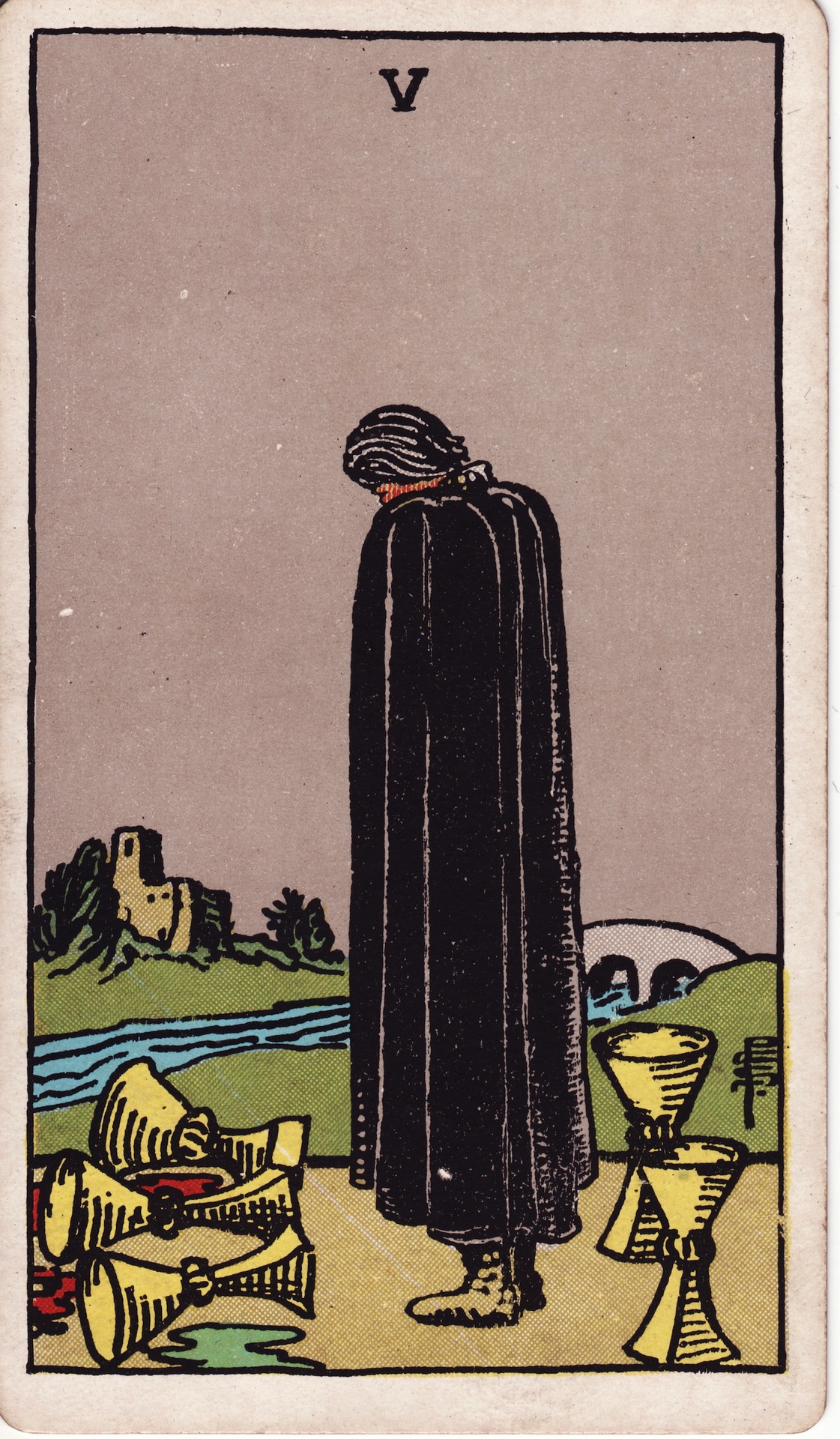
Five of Cups
The Five of Cups represents grief, disappointment, and emotional rupture. In the Rider–Waite deck, a cloaked figure mourns three spilled cups while two remain upright behind them, unnoticed. Where the Four of Cups depicts emotional disengagement through complacency, the Five of Cups shows the shock of loss that reawakens feeling. Emotion breaks open through sorrow.
This card marks the moment when expectation collapses. What was taken for granted is gone, and attention fixes on what has been lost rather than what endures.
Esoteric Meaning
In practical interpretation, the Five of Cups signifies:
- Loss and disappointment
- Grief and mourning
- Regret and fixation on the past
- Emotional setback
- Partial loss rather than total ruin
At a deeper level, the Five of Cups represents the purification of feeling through sorrow. Water here is disturbed violently, forcing awareness back into the heart. This card teaches that grief is not failure; it is a corrective force that restores sensitivity.
In its shadow aspect, the Five of Cups can indicate emotional fixation, self-pity, or refusal to acknowledge what remains. When loss defines identity, recovery is delayed.
The Five of Cups on the Tree of Life
In the Golden Dawn system, the Five of Cups is attributed to Geburah in Briah.
Geburah represents severity, correction, and necessary rupture. When expressed through Water, it produces emotional pain that cuts away illusion. The Five of Cups reflects feeling disciplined through loss.
This is sorrow that clears stagnation.
Symbolism in the Rider–Waite Deck
Each symbol reinforces grief and selective perception:
- The Spilled Cups: Emotional loss
- The Cloaked Figure: Withdrawal into mourning
- The Upright Cups: Remaining emotional resources
- The Bridge: Path toward recovery
- The Flowing River: Emotions still in motion
The Five of Cups teaches that grief narrows vision; but does not erase possibility.
Role in the Great Work
Within the Great Work, the Five of Cups represents the initiatory wound of the heart. After complacency dulls perception, loss reopens emotional awareness. This is the sorrow that re-sensitizes devotion and restores humility.
The card teaches discernment in grief. Mourning what is gone is natural, but the Work continues when attention turns toward what remains.
Where the Four of Cups stagnates through indifference, the Five of Cups awakens through pain.
FAQ 1: What does the Five of Cups represent in the Golden Dawn tradition?
In the Golden Dawn, the Five of Cups represents the disruption of Water; emotional and intuitive force subjected to severity. It governs loss, sorrow, and disappointment as corrective experiences that refine feeling and attachment.
FAQ 2: Is the Five of Cups only about grief or regret?
No. While grief is a visible aspect, the Five of Cups is not merely about sadness. In Golden Dawn teaching, it represents emotional purification, where attachments that no longer serve the Great Work are broken down through loss.
FAQ 3: How is the Five of Cups related to the Tree of Life?
The Five of Cups corresponds to Geburah in the world of Briah. Geburah introduces severity; in Briah, this manifests as emotional correction, sorrow that strips illusion, and the painful refinement of feeling.
FAQ 4: What elemental force governs the Five of Cups?
The Five of Cups is governed by the element of Water. Here, Water expresses itself as emotional depth under strain, revealing where feeling has become attached, dependent, or misaligned.
FAQ 5: How does the Five of Cups function initiatorily?
Initiatorily, the Five of Cups teaches the initiate to release emotional dependence. Loss becomes a teacher, revealing that true fulfillment does not arise from external attachment but from inner alignment and spiritual continuity.
FAQ 6: What happens when the Five of Cups is unbalanced or misunderstood?
When unbalanced, the Five of Cups may manifest as despair, fixation on loss, or emotional stagnation. In Golden Dawn doctrine, imbalance occurs when sorrow becomes self-identification rather than a passage toward purification.