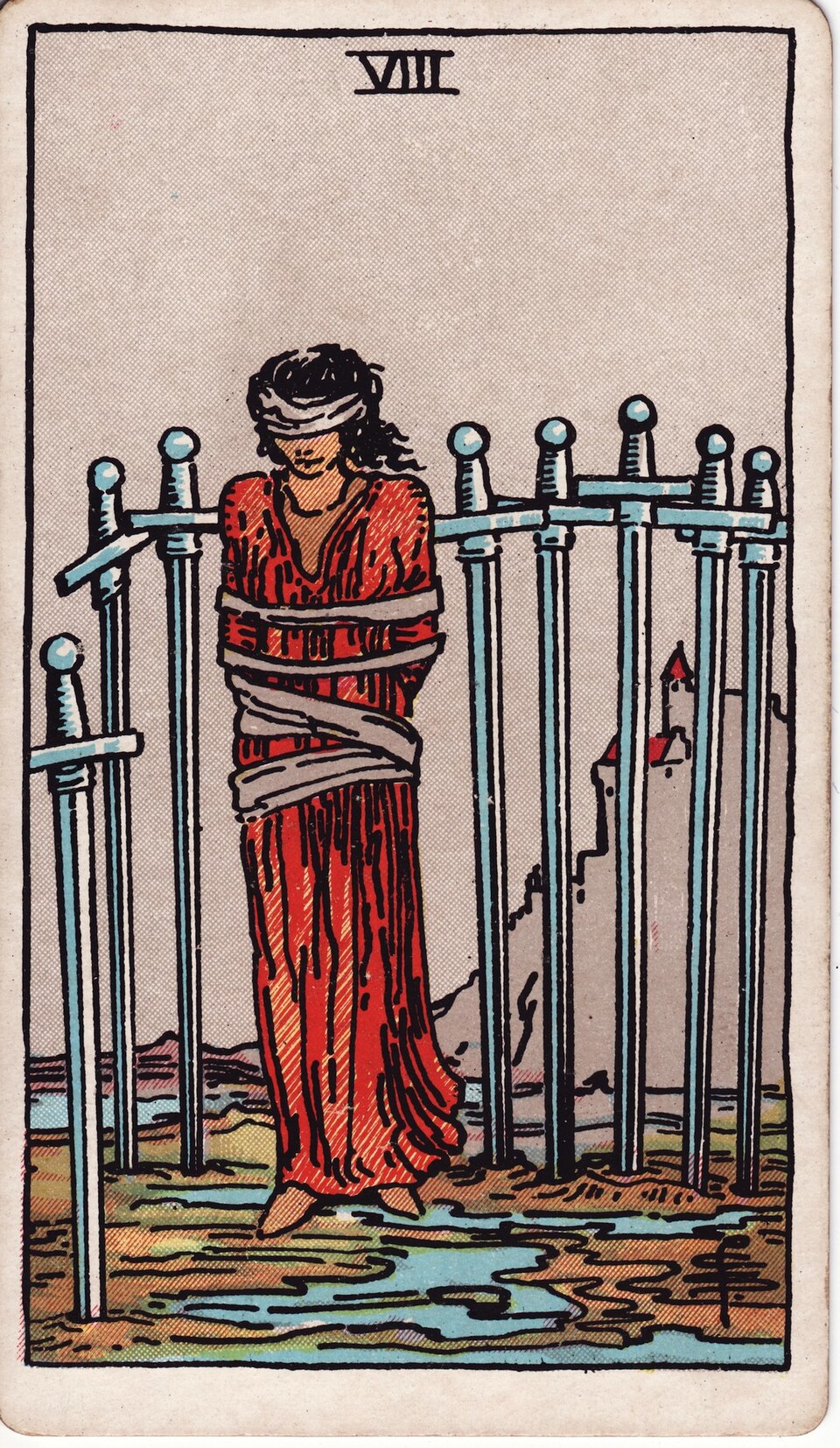
Eight of Swords
The Eight of Swords represents mental restriction, perceived helplessness, and limitation created by belief. In the Rider–Waite deck, a blindfolded figure stands bound amid a circle of swords, seemingly trapped yet not physically restrained beyond escape. Where the Seven of Swords depicts deceptive freedom, the Eight of Swords reveals self-imposed captivity.
This card marks the stage where intellect turns against itself. Thought becomes a prison constructed from fear, assumption, and misinterpretation rather than external force.
Esoteric Meaning
In practical interpretation, the Eight of Swords signifies:
- Mental restriction
- Feeling trapped or powerless
- Self-limiting beliefs
- Anxiety and paralysis
- Loss of perspective
At a deeper level, the Eight of Swords represents consciousness narrowed by illusion. It teaches that limitation often persists not because escape is impossible, but because perception is distorted. Awareness has been bound, not the self.
In its shadow aspect, the Eight of Swords can indicate resignation, learned helplessness, or refusal to challenge assumptions. When belief becomes fixed, clarity cannot enter.
The Eight of Swords on the Tree of Life
In the Golden Dawn system, the Eight of Swords is attributed to Hod in Yetzirah.
Hod governs analysis, logic, and structure. When expressed through Air, it produces over-intellectualization that restricts movement. The Eight of Swords reflects reason turned inward to justify paralysis.
This is intellect detached from intuition and compassion.
Symbolism in the Rider–Waite Deck
Each symbol reinforces perceived entrapment:
- The Blindfold: Lack of clear perception
- The Loose Bindings: Illusion of restriction
- The Circle of Swords: Mental barriers
- The Muddy Ground: Emotional stagnation
- The Distant Castle: Freedom appearing unreachable
The Eight of Swords teaches that the prison exists only while it is believed.
Role in the Great Work
Within the Great Work, the Eight of Swords represents the crisis of self-imposed limitation. After deception and avoidance, the practitioner confronts the consequences of unexamined belief. The Work halts until perception changes.
This card teaches that liberation begins with awareness. No external force can free what consciousness insists on confining.
Where the Seven of Swords avoids truth through cunning, the Eight of Swords suffers from avoidance.
FAQ 1: What does the Eight of Swords represent in the Golden Dawn tradition?
In the Golden Dawn, the Eight of Swords represents the refinement of Air; intellect organized into rigid structure. It governs mental restriction, analytical confinement, and the experience of limitation created by thought patterns rather than external forces.
FAQ 2: Is the Eight of Swords about being trapped by circumstances or other people?
No. While restriction is experienced, the Eight of Swords is not imposed externally. In Golden Dawn teaching, it represents self-created limitation, where excessive analysis and fixed ideas bind the mind within its own constructions.
FAQ 3: How is the Eight of Swords related to the Tree of Life?
The Eight of Swords corresponds to Hod in the world of Yetzirah. Hod governs intellect and structure; in Yetzirah, this manifests as tightly organized thought that restricts freedom when flexibility is lost.
FAQ 4: What elemental force governs the Eight of Swords?
The Eight of Swords is governed by the element of Air. Here, Air expresses itself as crystallized thought; logic that has become overly rigid, creating barriers rather than pathways.
FAQ 5: How does the Eight of Swords function initiatorily?
Initiatorily, the Eight of Swords teaches awareness of mental constructs. The initiate learns that clarity arises by loosening identification with thought, recognizing that intellectual structure must remain a tool, not a prison.
FAQ 6: What happens when the Eight of Swords is unbalanced or misunderstood?
When unbalanced, the Eight of Swords may manifest as paralysis, anxiety, or obsessive reasoning. In Golden Dawn doctrine, imbalance occurs when analysis overrides intuition and intellect loses contact with higher guidance.