Death
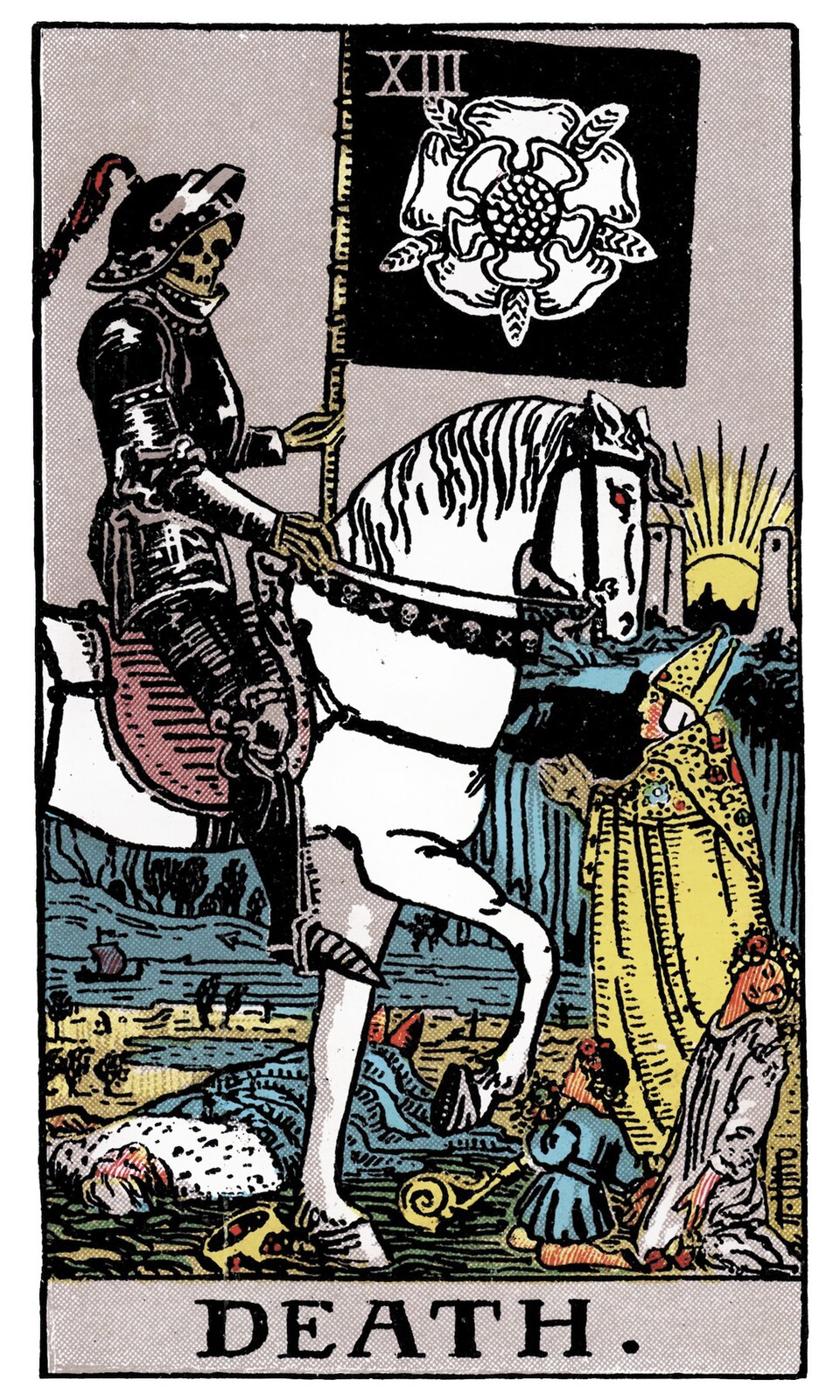
Death represents transformation, endings, and irreversible change. In the Rider–Waite deck, a skeletal figure rides forth carrying a black banner emblazoned with a white rose, while figures of all ranks fall before it. Where the Hanged Man suspends and inverts perception, Death cuts cleanly. This card is not about physical death, but about the necessary ending of forms that can no longer support growth.
Numbered XIII, Death signifies finality that leads to renewal. It marks the point at which surrender becomes release, and release becomes rebirth. What is taken away is not destroyed out of cruelty, but because continuation would prevent transformation.
Esoteric Meaning
In practical interpretation, Death signifies:
- Endings and closure
- Transformation and renewal
- Letting go of the obsolete
- Irreversible change
- Transition between states
At a deeper level, Death represents the alchemical putrefaction stage; the dissolution of fixed identity so that something new may arise. This card teaches that clinging to expired structures delays growth and intensifies suffering. True renewal requires complete separation from what has already fulfilled its purpose.
In its shadow aspect, Death can indicate fear of change, stagnation, or prolonged attachment to the past. When endings are resisted, transformation becomes painful rather than liberating.
Death on the Tree of Life
In the Golden Dawn system, Death corresponds to the Hebrew letter Nun (נ) and is assigned to Path 24 on the Tree of Life.
- Path: 24
- Connects: Tiphareth (Beauty) → Netzach (Victory)
- Hebrew Letter: Nun
- Astrological Attribution: Scorpio
Nun means “fish,” symbolizing life hidden beneath the surface and continuity through transformation. This path channels the balanced self-awareness of Tiphareth into the realm of desire, instinct, and emotional momentum found in Netzach. Death purifies attachment so that desire may be renewed rather than compulsive.
Scorpio governs death, rebirth, secrecy, and transformation, making it the most fitting attribution for this card’s role as agent of profound change.
Symbolism in the Rider–Waite Deck
Each symbol reinforces the inevitability and purpose of transformation:
- The Skeletal Figure: What remains when illusion falls away
- The Black Banner: Finality and negation of form
- The White Rose: Purity born from dissolution
- The Rising Sun: Renewal beyond endings
- The Fallen Figures: Universality of transformation
Death does not discriminate, it equalizes.
Role in the Great Work
Within the Great Work, Death represents the true initiation into transformation. After surrender and suspension, the practitioner must now allow the old self to end completely. This is the severing of outdated identity, belief, and attachment.
Death teaches that transformation is not gradual refinement alone; sometimes it requires absolute termination. Only when the old form is gone can a new one be consciously constructed.
Where the Hanged Man releases control, Death removes the attachment entirely.
FAQ 1: What does the Death card represent in the Golden Dawn tradition?
In the Golden Dawn, Death represents transformation through the complete ending of a former state. It governs the dissolution of identity, structures, and patterns that can no longer support growth, making space for genuine renewal.
FAQ 2: Does the Death card mean physical death in Golden Dawn teaching?
No. The Death card does not signify physical death. In Golden Dawn doctrine, it represents initiatory death; the irreversible ending of a way of being so that consciousness may be reborn on a higher level.
FAQ 3: How is Death associated with the Tree of Life?
Death corresponds to the path connecting Netzach (Victory) to Tiphareth (Beauty). This path represents the purification of desire and attachment so that true identity may emerge free from illusion.
FAQ 4: What planetary or zodiacal force is associated with Death?
In the Golden Dawn system, Death is associated with Scorpio and ruled by Mars. This reflects disciplined force applied inwardly to sever false attachments and drive transformation rather than destruction for its own sake.
FAQ 5: How does Death function initiatorily?
Initiatorily, Death follows The Hanged Man by completing surrender through dissolution. What was relinquished voluntarily is now released permanently. This stage marks a point of no return within the initiatory cycle.
FAQ 6: What happens when Death is resisted or misunderstood?
When resisted, Death manifests as fear, stagnation, or repeated crisis. In Golden Dawn teaching, refusal to let go prolongs suffering. Acceptance allows transformation to occur cleanly, making renewal possible.
FAQ 7: Why is Death essential to the Great Work?
Death is essential because the Great Work requires real change, not cosmetic adjustment. Without death of illusion and false identity, initiation remains superficial. Death ensures that transformation is authentic and irreversible.