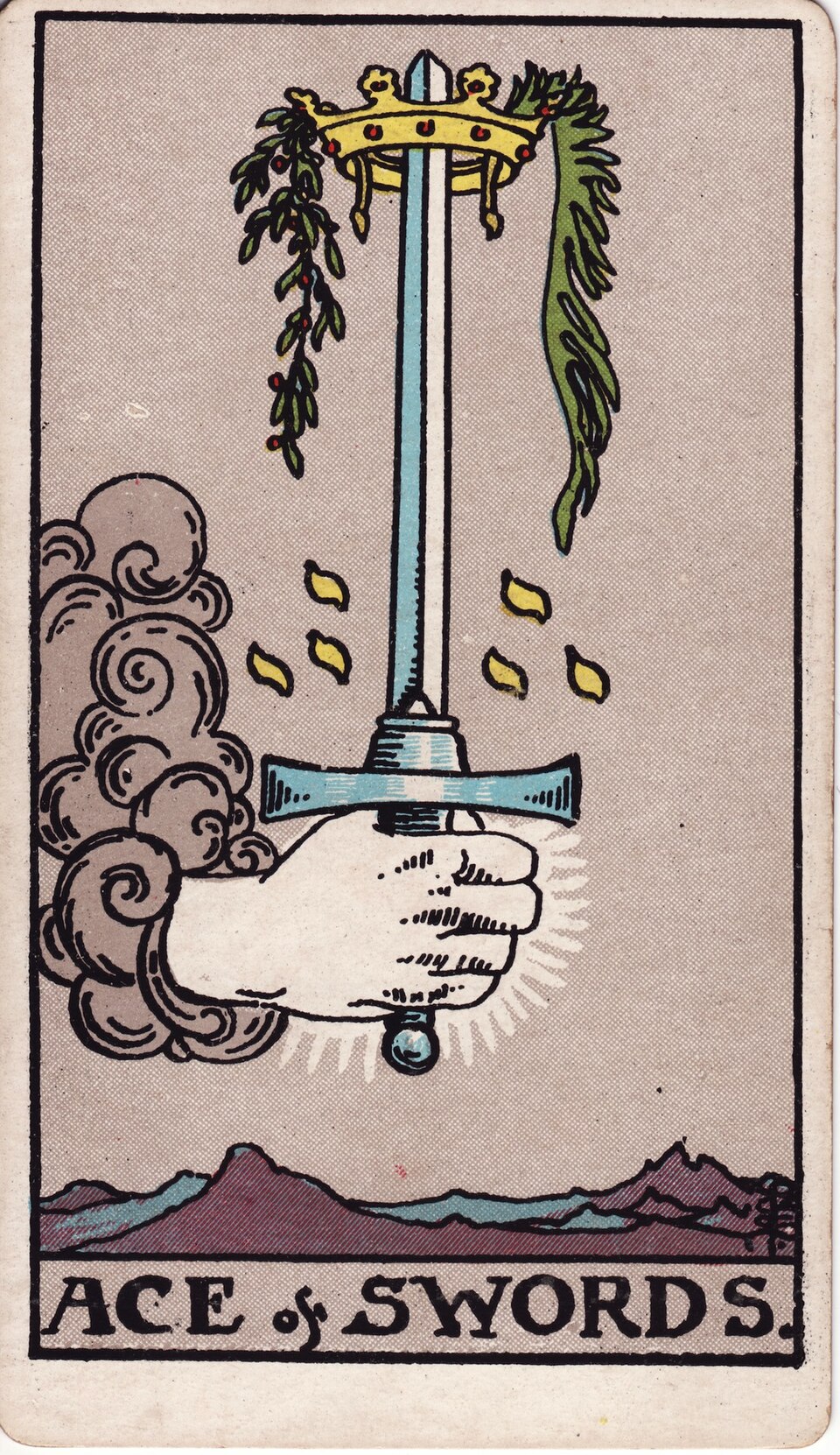
Ace of Swords
The Ace of Swords represents clarity, truth, and the birth of conscious thought. In the Rider–Waite deck, a crowned sword is held aloft by a divine hand emerging from the clouds, cutting cleanly through confusion and illusion. Where the Pentacles address manifestation and material reality, the Swords turn the focus inward to mind, perception, and discernment.
As an Ace, this card signifies pure potential; not an argument, decision, or conflict yet formed, but the capacity for understanding itself. It is awareness before opinion, truth before interpretation.
Esoteric Meaning
In practical interpretation, the Ace of Swords signifies:
- Mental clarity and insight
- Truth revealed
- New ideas or realizations
- Intellectual awakening
- Clear communication
At a deeper level, the Ace of Swords represents the descent of divine reason into consciousness. It is the moment when confusion is pierced by understanding and when illusion collapses under direct perception. This card teaches that clarity is not gentle; it is precise.
In its shadow aspect, the Ace of Swords can indicate intellectual arrogance, misuse of truth as a weapon, or ideas divorced from compassion. When clarity lacks wisdom, it becomes cruelty.
The Ace of Swords on the Tree of Life
In the Golden Dawn system, the Ace of Swords is attributed to Kether in Yetzirah, the World of Formation.
Kether represents pure divine consciousness. When expressed through Air, it becomes pure awareness and intellect; the first articulation of thought before form or emotion distorts it. The Ace of Swords is the archetypal spark of reason.
This is consciousness realizing itself as mind.
Symbolism in the Rider–Waite Deck
Each symbol reinforces truth and precision:
- The Upright Sword: Discernment and authority of truth
- The Crown: Sovereignty of clear awareness
- The Laurel and Palm: Victory through understanding
- The Clouds: Mental confusion being pierced
- The Disembodied Hand: Divine origin of intellect
The Ace of Swords does not negotiate; it reveals.
Role in the Great Work
Within the Great Work, the Ace of Swords represents the awakening of the discriminating mind. After mastery of matter, the initiate turns toward truth, logic, and perception. This is the realization that liberation requires clarity as much as devotion.
The card teaches that the mind is a sacred tool when aligned with truth. Thought must be sharpened, not dulled by fear or attachment.
Where the Ace of Pentacles grounds spirit into matter, the Ace of Swords cuts spirit free from illusion.
FAQ 1: What does the Ace of Swords represent in the Golden Dawn tradition?
In the Golden Dawn, the Ace of Swords represents the pure root of Air—the undifferentiated potential of intellect, truth, and conscious perception. It signifies the birth of clarity before thought becomes opinion or belief.
FAQ 2: Is the Ace of Swords a card of conflict or aggression?
No. While conflict may arise from truth, the Ace of Swords is not inherently violent. In Golden Dawn teaching, it represents discrimination and clarity—the power to distinguish truth from falsehood through conscious awareness.
FAQ 3: How is the Ace of Swords related to the Tree of Life?
The Ace of Swords corresponds to Kether in the world of Yetzirah. This placement represents the divine source of mental activity; the initial flash of awareness from which all structured thought emerges.
FAQ 4: What elemental force governs the Ace of Swords?
The Ace of Swords is governed by the element of Air. This reflects intellect, communication, discernment, and the capacity to separate, define, and understand reality through reason.
FAQ 5: How does the Ace of Swords function initiatorily?
Initiatorily, the Ace of Swords marks the awakening of conscious understanding. It represents the moment when the initiate becomes capable of recognizing truth directly, cutting through illusion and confusion.
FAQ 6: What happens when the Ace of Swords is unbalanced or misunderstood?
When misunderstood, the Ace of Swords may manifest as harshness, dogmatism, or intellectual arrogance. In Golden Dawn doctrine, imbalance occurs when intellect is divorced from compassion and spiritual purpose.