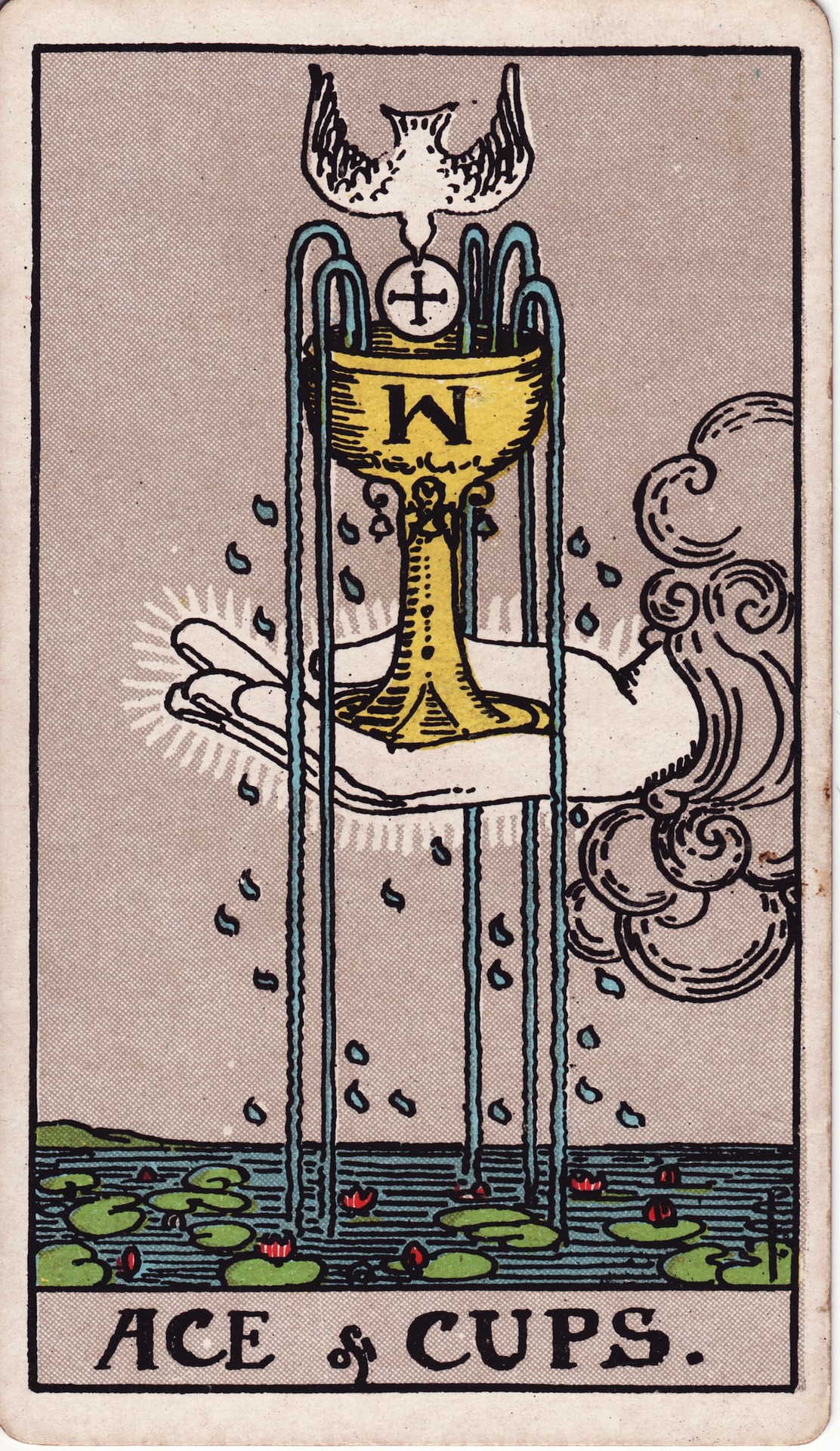
Ace of Cups
The Ace of Cups represents pure emotional potential, spiritual receptivity, and the birth of inner awareness. In the Rider–Waite deck, a divine hand emerges from the clouds offering an overflowing chalice, from which water pours into a tranquil pool below. Where the Wands ignite will and action, the Cups turn inward toward feeling, devotion, and the inner life. This is the opening of the heart.
As an Ace, this card signifies undifferentiated potential; emotion before attachment, love before relationship, devotion before expression. It is the source from which all emotional experience flows.
Esoteric Meaning
In practical interpretation, the Ace of Cups signifies:
- Emotional openness
- New beginnings in love or connection
- Spiritual receptivity
- Compassion and empathy
- Inner renewal
At a deeper level, the Ace of Cups represents the descent of divine grace into consciousness. It teaches that transformation is not sustained by will or intellect alone, but by the capacity to receive. This is the cup made ready to be filled.
In its shadow aspect, the Ace of Cups can indicate emotional overwhelm, misplaced idealism, or spiritual bypassing. When receptivity lacks grounding, feeling floods without containment.
The Ace of Cups on the Tree of Life
In the Golden Dawn system, the Ace of Cups is attributed to Kether in Briah, the World of Creation.
Kether represents pure divine source. When expressed through Water, it becomes pure feeling and spiritual intuition; the wellspring of compassion, devotion, and inner life. The Ace of Cups is the archetypal heart, open and undefended.
This is consciousness experienced as receptivity.
Symbolism in the Rider–Waite Deck
Each symbol reinforces emotional and spiritual abundance:
- The Overflowing Cup: Infinite emotional potential
- The Dove: Divine grace and spiritual blessing
- The Falling Drops: Descent of spirit into feeling
- The Still Water: Depth of the unconscious
- The Disembodied Hand: Transcendent origin of emotion
The Ace of Cups does not demand; it offers.
Role in the Great Work
Within the Great Work, the Ace of Cups represents the awakening of the heart. After mastery of will and action, the initiate must now learn receptivity, devotion, and emotional truth. The Work deepens when it is felt, not just pursued.
The card teaches that love, compassion, and inner alignment are not rewards; they are sources. Without Water, Fire burns itself out.
Where the Ace of Wands ignites purpose, the Ace of Cups consecrates it.
FAQ 1: What does the Ace of Cups represent in the Golden Dawn tradition?
In the Golden Dawn, the Ace of Cups represents the pure root of Water—the undifferentiated potential of receptivity, consciousness, and inner life. It signifies the capacity to receive spiritual influence before emotion becomes attachment or sentiment.
FAQ 2: Is the Ace of Cups only about love or romantic relationships?
No. While love may be an expression of it, the Ace of Cups is not limited to romance. In Golden Dawn teaching, it represents receptive consciousness itself; the vessel through which spiritual force is felt, absorbed, and internalized.
FAQ 3: How is the Ace of Cups related to the Tree of Life?
The Ace of Cups corresponds to Kether in the world of Briah. This placement represents the divine source of emotion and intuition; the first descent of spiritual influence into the realm of formative consciousness.
FAQ 4: What elemental force governs the Ace of Cups?
The Ace of Cups is governed by the element of Water. Water represents receptivity, reflection, emotional depth, intuition, and the capacity to hold and transmit spiritual influence.
FAQ 5: How does the Ace of Cups function initiatorily?
Initiatorily, the Ace of Cups marks the awakening of inner sensitivity. It is the moment when the initiate becomes capable of receiving spiritual impressions consciously, opening the heart and inner awareness to higher influence.
FAQ 6: What happens when the Ace of Cups is unbalanced or misunderstood?
When misunderstood, the Ace of Cups may manifest as emotional dependency, sentimentality, or escapism. In Golden Dawn doctrine, imbalance occurs when receptivity lacks discernment or grounding in higher purpose.