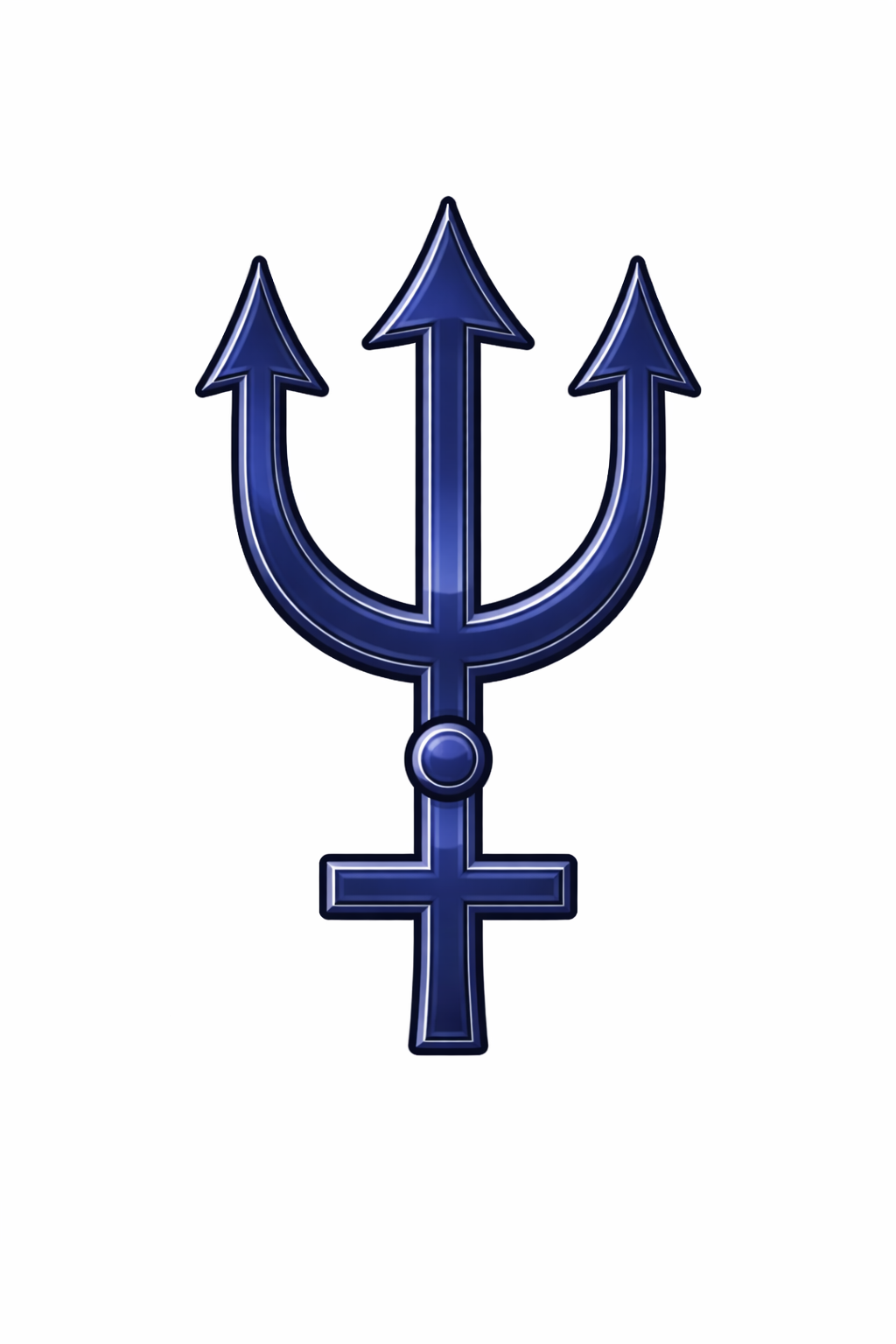
Neptune — Mysticism, Dissolution, and the Ocean of Divine Unity
In the Western Esoteric Tradition, Neptune represents mystical dissolution, spiritual transcendence, and the loss of separation between self and the infinite. Though unknown to the ancient astrologers, Neptune has been incorporated into later Hermetic and Golden Dawn–influenced systems as the planetary force governing mysticism, devotion, illusion, and divine unity. Neptune dissolves boundaries, inviting consciousness to surrender individuality and merge with the greater spiritual whole.
Neptune is not revelation by lightning, but immersion into the sacred ocean.
Neptune on the Tree of Life — Kether (Modern Attribution)
In modern Hermetic and Golden Dawn–influenced Qabalistic models, Neptune is often associated with Kether, the first Sephirah on the Tree of Life, representing Unity, Source, and the unmanifest Absolute.
Kether governs:
- Divine unity
- Pure being beyond form
- Infinite consciousness
- The origin of all emanation
Neptune aligns with Kether as the force that dissolves all distinctions, drawing awareness back toward the Source from which all differentiation arises. Where Uranus awakens the mind to higher truth, Neptune dissolves the mind entirely into spiritual unity.
Symbolism and Meaning of Neptune
Esoterically, Neptune symbolizes the return to the divine ocean; the formless realm from which all manifestation emerges and to which it ultimately returns.
Neptune governs:
- Mysticism and spiritual devotion
- Compassion and empathy
- Illusion and transcendence
- Psychic permeability
Its symbol reflects the trident rising from the sea, representing spirit emerging briefly from unity before dissolving again into the infinite.
Neptune and the Great Work
Within the Great Work, Neptune represents the stage of spiritual surrender and transcendence. After Uranus breaks false structures and awakens higher perception, Neptune carries the aspirant beyond perception itself.
This stage involves:
- Dissolution of ego boundaries
- Devotional surrender
- Mystical union
- Release of personal identity
Neptune teaches that enlightenment is not achieved through control or mastery, but through complete surrender to divine will.
The Neptunian Mystery — Unity Beyond Form
A central mystery of Neptune is that truth cannot always be defined, only experienced. In Golden Dawn–influenced teachings, Neptune governs the mystical states where language, logic, and symbol fall away.
Neptune teaches:
- That separation is illusion
- That compassion arises from unity
- That surrender completes the Work
This is why Neptune is associated with saints, mystics, visionaries, and martyrs; but also with confusion and illusion when discernment is lacking.
Psychological and Spiritual Function
Psychologically, Neptune governs empathy, imagination, and boundary dissolution. It shapes sensitivity to collective emotion, spiritual longing, and the unseen.
Balanced Neptunian expression produces:
- Compassion without self-erasure
- Mysticism with discernment
- Spiritual devotion grounded in humility
When distorted, Neptune manifests as escapism, delusion, or loss of self; imbalances corrected through Saturnian structure and Mercurial clarity.
Ritual and Magical Associations
In Hermetic and Golden Dawn–derived practice, Neptune is associated with:
- Deep blue and sea-green hues
- Water symbolism and vessels
- Chant, music, and devotional prayer
- Incense of myrrh or lotus
- Liminal states and altered consciousness
Neptunian workings are used for mystical communion, devotional practice, psychic opening, compassion work, and transcendence rituals.
Neptune as the Dissolver of the Work
Neptune ensures that the Great Work does not end in identity, power, or structure. It returns all attainment back to the divine ocean, preventing spiritual pride and fixation.
Without Neptune, the Work hardens into doctrine.
With Neptune, the Work melts back into spirit.
Closing Reflection — The Neptunian Path
The Golden Dawn teaches that the final stages of initiation require not assertion, but surrender. Neptune reveals that enlightenment is not something the self possesses; it is something the self dissolves into.
To walk the Neptunian path is to:
- Release attachment to form
- Embrace divine mystery
- Love without boundary
Where Uranus awakens and Saturn defines,
Neptune unites.
Through Kether’s boundless sea, the Work dissolves;
and the soul returns to the Source.
FAQ 1: What does Neptune represent in Golden Dawn–aligned practice?
In Golden Dawn–aligned modern practice, Neptune represents dissolution, transcendence, and the experience of unity beyond form. It governs the breaking down of rigid boundaries so consciousness can perceive the interconnected nature of reality underlying the Great Work.
FAQ 2: Is Neptune part of the original Golden Dawn planetary system?
Neptune was not included in the original classical Golden Dawn system, which focused on the seven visible planets. In modern integration, Neptune is understood as a transpersonal force that complements the classical framework by addressing collective mysticism, spiritual depth, and the dissolution of ego boundaries.
FAQ 3: How does Neptune differ from the Moon in the Golden Dawn worldview?
The Moon governs reflection, transmission, and the astral medium, while Neptune dissolves the boundaries of the astral entirely. In Golden Dawn–aligned doctrine, the Moon refines perception within form, whereas Neptune reveals what lies beyond form itself.
FAQ 4: Is Neptune associated with illusion or deception in magic?
Neptune can produce illusion when unbalanced, but it is not inherently deceptive. In Golden Dawn understanding, illusion arises when dissolution occurs without structure. Proper integration of Neptune leads to spiritual depth and compassion rather than confusion or escapism.
FAQ 5: How does Neptune function initiatorily?
Initiatorily, Neptune introduces experiences of surrender, unity, and transcendence that dissolve rigid identity. These experiences challenge the practitioner to integrate compassion, humility, and depth without losing coherence or responsibility.
FAQ 6: What happens when Neptune is unbalanced?
Excess Neptune may manifest as escapism, confusion, or spiritual bypassing, while deficient Neptune can result in dryness, cynicism, or resistance to transcendence. Golden Dawn–aligned practice integrates Neptune carefully to preserve clarity while allowing spiritual depth.
FAQ 7: Why is Neptune considered a transpersonal planetary force?
Neptune is considered transpersonal because its influence extends beyond individual psychology into collective consciousness. It governs shared ideals, mystical longing, and humanity’s relationship to the infinite, operating on levels that transcend personal desire or identity.