The Golden Dawn Grades — What Each Grade Actually Trains (And Why the System Still Works)
Within the Hermetic Order of the Golden Dawn, the grade system is not a social hierarchy, a roleplay ladder, or a collection of ornate titles. It is a deliberate initiatory architecture designed to train the aspirant’s consciousness through distinct stages of development. Each grade is a structured environment: it refines specific faculties of perception, stabilizes particular energies, and confronts the aspirant with the exact kind of transformation required for the Great Work.
This is why the Golden Dawn remains structurally superior to much of modern occultism. Modern systems often offer fragments; rituals without doctrine, symbolism without discipline, inspiration without an operating system. The Golden Dawn grades, by contrast, operate like a curriculum of initiation. They build a stable foundation first, then refine the inner instruments, then awaken deeper powers only when the vessel is capable of bearing them. The result is coherence: a path where the inner world becomes ordered, integrated, and aligned with universal law.
The grades are also inseparable from the Tree of Life. They are not merely “associated” with Qabalah; they are designed to initiate the aspirant into specific Sephiroth, progressively establishing consciousness within each sphere as a lived reality rather than an idea. In this framework, each initiation is not a badge. It is a change of relationship to mind, emotion, will, energy, and ultimately to Being itself.
Below is a practical overview of each grade and what it trains, including the Sephirah each grade is initiated into. Each grade also serves as a doorway to deeper study; because the Golden Dawn is not mastered by memorizing correspondences, but by becoming the kind of consciousness those correspondences describe.
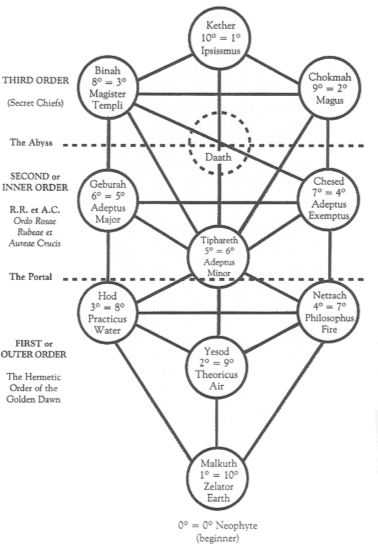
The Golden Dawn Grade Ladder at a Glance
0 = “Uninitiated” / Neophyte — The Threshold of the Work
Status: Associated with the uninitiated (the state prior to true establishment in the spheres)
Neophyte is the threshold condition: the moment the aspirant turns from curiosity toward discipline. This stage trains the most fundamental skill of the entire system: symbolic awareness; the ability to hold ritual, doctrine, and inner experience without collapsing them into fantasy or skepticism. Neophyte work focuses on orientation, purification, aspiration, and the beginning of inner order. It is the doorway where the work stops being aesthetic and becomes initiatory.
The Outer Order Grades (The Foundation of Initiation)
1 = Zelator — Initiated into Malkuth
Sephirah: Malkuth (Kingdom)
Zelator is the grade of grounding, embodiment, and stability. It trains attention in the physical world and teaches the aspirant to master the base conditions of the Work: discipline, practice, and energetic containment. This grade develops endurance, sensory clarity, and the ability to build real structure; because without Malkuth, spiritual work becomes ungrounded and unstable. Zelator is where the aspirant learns that initiation must be lived in the body.
2 = Theoricus — Initiated into Yesod
Sephirah: Yesod (Foundation)
Theoricus trains inner structure, imagination, and the foundational mechanisms of the subtle body. Yesod governs dreams, symbolic cognition, astral perception, and the formative patterns that shape reality. In this grade the aspirant learns how inner images form, how symbols operate, and how subconscious patterns govern perception. Theoricus is where the student begins to understand that “the astral” is not escapism; it is the blueprint layer of experience.
3 = Practicus — Initiated into Hod
Sephirah: Hod (Splendor)
Practicus develops intellect, analysis, discrimination, and the ability to articulate truth without distortion. Hod governs language, logic, classification, and symbolic systems. This grade trains clarity of mind and the power of precise correspondence; because without Hod, spiritual experience becomes confusion. Practicus is where the aspirant learns to organize knowledge into usable structure, and to separate true insight from emotional projection.
4 = Philosophus — Initiated into Netzach
Sephirah: Netzach (Victory)
Philosophus refines desire, emotion, attraction, repulsion, and the raw forces that drive the personality. Netzach governs the energetic tides of love, passion, aesthetic magnetism, and instinctive response. In this grade the aspirant learns emotional mastery; not repression, but transmutation. Philosophus trains the ability to hold intensity without being ruled by it, and to align desire with higher law. This grade is where many aspirants fail, because it demands real transformation rather than intellectual comfort.
The Portal and the Adept Grades (The Inner Order Current)
5 = Adeptus Minor — Initiated into Tiphareth
Sephirah: Tiphareth (Beauty)
Adeptus Minor is the grade of solar integration: the alignment of identity with the Higher Self. Tiphareth is the sphere of harmony, redemption, and central equilibrium. Here the Work becomes explicitly initiatory in the deepest sense; because the aspirant must unify scattered parts of the psyche into a coherent center. Adeptus Minor trains the ability to act from inner authority rather than social conditioning, and to bring balance to the whole system of the self.
6 = Adeptus Major — Initiated into Geburah
Sephirah: Geburah (Severity/Strength)
Adeptus Major refines will, discipline, courage, and corrective force. Geburah is not cruelty; it is spiritual surgery. This grade trains the aspirant to cut away illusion, weakness, and falsehood with precision, without egoic violence. It develops spiritual strength: the capacity to enforce alignment, uphold boundaries, and endure truth even when truth burns. In the Great Work, Geburah is the furnace that purifies.
7 = Adeptus Exemptus — Initiated into Chesed
Sephirah: Chesed (Mercy)
Adeptus Exemptus expands consciousness into true rulership, lawful expansion, and benevolent authority. Chesed governs the power to guide, bless, and sustain order without domination. This grade trains spiritual leadership and the capacity to wield power responsibly. Chesed is the sphere of great structures; systems that uplift rather than enslave. In this initiation, the aspirant learns that true mastery is not control, but alignment with higher law and constructive force.
The Supernal Grades (Beyond the Ordinary Personality Structure)
8 = Magister Templi — Initiated into Binah
Sephirah: Binah (Understanding)
Magister Templi is the grade of form, comprehension, and the deep architecture of reality. Binah governs structure, limitation, sacred law, and the matrix through which force becomes intelligible. This grade represents a profound shift: the aspirant becomes capable of holding vast spiritual truth without distortion. It is the intelligence that can contain power without scattering it. Binah is the “womb of initiation,” where wisdom becomes coherent doctrine and living law.
9 = Magus — Initiated into Chokmah
Sephirah: Chokmah (Wisdom)
Magus is the initiation into pure wisdom-force, the dynamic current that precedes form. Chokmah is expansive, electric, and archetypally creative. This grade represents mastery of the current of wisdom itself; where speech, will, and presence transmit force. In a real initiatory sense, Chokmah is not opinion or philosophy: it is the direct radiance of intelligence moving through existence.
10 = Ipsissimus — Initiated into Kether
Sephirah: Kether (Crown)
Ipsissimus is the initiation into unity, the crown of the Tree, the state beyond division. Kether is not merely “enlightenment” in a modern motivational sense; it is the realization of Being as source; before the mind splits reality into subject and object. This grade signifies completion, not as a trophy, but as the full integration of consciousness into its origin. In Kether, the Great Work resolves into silence, presence, and pure causality.
Why This Grade System Still Matters
The Golden Dawn grades endure because they describe how consciousness actually evolves when trained with discipline. Each grade develops a faculty that the next grade requires. This is why skipping steps breaks the Work: you can’t stabilize Yesod if Malkuth is chaotic; you can’t master Hod if Netzach is raging; you can’t integrate Tiphareth if the personality remains fragmented.
This is also why Golden Dawn tools matter: they are not props, but training instruments designed to encode this entire system into ritual action and symbol. The grade structure is not theoretical; it is meant to be lived, practiced, embodied, and built into the very nervous system of the aspirant.
In the pages linked throughout this grade hub, each grade will be explored in detail: its function, its psychological development, its initiatory tests, its relationship to the Tree of Life, and its practical implications for the Great Work. Studied properly, the grade system stops being “a list” and becomes what it was always meant to be: a coherent operating system for transformation.
What is the Golden Dawn grade system?
The Golden Dawn grade system is a structured initiatory framework designed to train consciousness through progressive stages of development. Each grade cultivates specific psychological, energetic, and perceptual faculties, guiding the aspirant through the Tree of Life as a lived initiatory process rather than a symbolic abstraction.
Are the Golden Dawn grades just titles or ranks?
No. The grades are not honorary titles or social ranks. Each grade represents a distinct mode of consciousness that must be stabilized before advancement. Advancement without integration undermines the system and leads to fragmentation rather than initiation.
Why are the Golden Dawn grades associated with the Tree of Life?
Each grade corresponds to initiation into a specific Sephirah on the Tree of Life. This reflects the Golden Dawn understanding that spiritual development follows an intelligible structure, with each sphere representing a functional aspect of consciousness that must be integrated in sequence.
What does the Neophyte grade represent?
The Neophyte grade represents the threshold of initiation. It is associated with the uninitiated state and focuses on orientation, purification, and the development of symbolic awareness. Neophyte work establishes the conditions necessary for true initiatory development to begin.
Why does Zelator begin with Malkuth?
Zelator initiates the aspirant into Malkuth, the sphere of embodiment and stability. The Golden Dawn begins its work in the material world because spiritual development without grounding leads to instability, fantasy, and imbalance.
What is trained in the Theoricus grade?
Theoricus, associated with Yesod, trains imagination, inner structure, and the foundational mechanisms of the subtle body. This grade develops the aspirant’s capacity to understand symbols, dreams, and formative patterns without becoming lost in them.
Why is intellectual clarity emphasized in Practicus?
Practicus, initiated into Hod, trains discrimination, analysis, and structured thought. Without Hod, spiritual experience becomes incoherent. This grade teaches the aspirant how to organize knowledge into functional systems rather than emotional impressions.
What makes the Philosophus grade difficult?
Philosophus, associated with Netzach, requires mastery of emotion, desire, and instinctual forces. This grade challenges the aspirant to transmute passion rather than suppress it, aligning desire with higher law instead of personal impulse.
What changes at Adeptus Minor?
Adeptus Minor represents initiation into Tiphareth, the sphere of harmony and the Higher Self. This grade marks the integration of identity around a central solar principle, transforming the aspirant from a fragmented personality into a coherent spiritual agent.
What is the function of Geburah in Adeptus Major?
Adeptus Major initiates the aspirant into Geburah, the sphere of strength and corrective force. This grade trains disciplined will, boundary enforcement, and the capacity to confront truth without distortion or cruelty.
Why is Adeptus Exemptus associated with Chesed?
Adeptus Exemptus initiates the aspirant into Chesed, the sphere of mercy and lawful expansion. This grade develops spiritual authority, leadership, and the ability to guide systems constructively without domination.
What does the Magister Templi grade signify?
Magister Templi represents initiation into Binah, the sphere of understanding and form. This grade stabilizes wisdom into coherent structure, allowing the aspirant to hold profound truths without fragmentation or excess.
What is the role of the Magus grade?
The Magus grade initiates consciousness into Chokmah, the sphere of wisdom-force. This level represents mastery of dynamic intelligence itself, where will, speech, and presence transmit archetypal force rather than personal opinion.
What does Ipsissimus mean in the Golden Dawn system?
Ipsissimus represents initiation into Kether, the Crown of the Tree of Life. It signifies unity beyond division, where the Great Work resolves into pure being rather than further development or refinement.
Can the Golden Dawn grades be skipped or compressed?
No. Skipping grades disrupts the structural integrity of the system. Each grade prepares the consciousness for the next by stabilizing specific faculties. Compression leads to imbalance, confusion, and spiritual instability.
Is self-initiation possible in the Golden Dawn system?
Yes but, Self-initiation is often misunderstood. While inner work is essential, the Golden Dawn grades require disciplined structure, symbolic containment, and progressive integration. Attempting to self-initiate without proper grounding frequently results in incomplete or distorted development.
Why does the Golden Dawn grade system still matter today?
The grade system remains relevant because it describes how consciousness actually develops when trained systematically. In an era of fragmented spirituality, the Golden Dawn offers a coherent initiatory path capable of producing stable, integrated transformation.
How do Golden Dawn tools relate to the grades?
Golden Dawn tools are training instruments, not ceremonial props. Each tool encodes doctrinal principles aligned with the grade structure, reinforcing the psychological and energetic work required at each stage of initiation.
Where should a beginner start in the Golden Dawn system?
A beginner should begin by understanding the Neophyte condition and the foundational Outer Order grades. Attempting advanced material without completing foundational work undermines the initiatory process.