Chesed — Mercy on the Tree of Life
Within the Hermetic Order of the Golden Dawn, Chesed represents the principle of Mercy, not as sentiment or leniency, but as ordered expansion, stability, and beneficent authority. It is the first Sephirah below the Supernal Triangle and marks the point at which divine principles begin to operate within a governed, intelligible structure.
Chesed translates the abstract forces of the Supernals into sustaining order. Where Binah establishes form and limitation, Chesed governs how that form expands responsibly. It is the sphere of rulership, law, and continuity; the intelligence that ensures systems grow without collapsing into chaos.
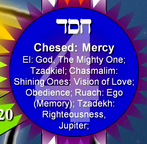
The Nature of Chesed
Chesed represents expansion guided by structure. It is the principle that allows growth to occur within boundaries rather than against them. In Golden Dawn doctrine, Mercy does not mean indulgence; it means supporting what is constructive and life-preserving.
Chesed governs:
- Authority exercised with balance
- Order that encourages growth
- Stability across systems
- Preservation of coherence over time
It is the Sephirah that ensures the universe does not fragment after form has been established. Chesed stabilizes expansion so that creation may endure.

Chesed as a Functional Organ of Consciousness
As a psychological and spiritual organ within the Tree’s operating system, Chesed governs the capacity to hold responsibility and authority without domination. It is the faculty that allows an individual to guide, protect, and sustain without over-control.
Psychologically, Chesed manifests as:
- Leadership grounded in wisdom
- Confidence without arrogance
- Trust in lawful order
- Generosity guided by discernment
When Chesed is weak, individuals resist responsibility or misuse freedom. When Chesed is excessive without balance, authority becomes rigid or paternalistic. Properly integrated, Chesed produces stable leadership and ethical power.
Chesed and Jupiter
In the Golden Dawn Universe framework, Chesed is associated with Jupiter, the planet of expansion, law, benevolence, and sovereign authority. Jupiter expresses Chesed’s essential nature: growth through order and wisdom rather than impulse.
Jupiterian energy is expansive, but not chaotic. It governs systems of law, education, religion, and governance; structures designed to support collective flourishing. This mirrors Chesed’s role on the Tree as the stabilizing force that allows divine principles to manifest as enduring institutions rather than fleeting expressions.
When Jupiter operates harmoniously through Chesed, it produces:
- Justice tempered by compassion
- Authority that inspires trust
- Expansion aligned with ethical order
When distorted, Jupiterian excess manifests as arrogance, dogmatism, or unchecked dominance; signs of Chesed unbalanced by Geburah.
Chesed and the Pillar of Mercy
Chesed stands at the summit of the Pillar of Mercy, representing the expansive current of the Tree. This pillar governs growth, generosity, and outward movement. However, expansion alone is insufficient. Chesed’s position opposite Geburah establishes the essential polarity that maintains balance.
Mercy without Severity becomes indulgence.
Severity without Mercy becomes cruelty.
Chesed must therefore operate in conscious tension with Geburah to preserve equilibrium within the system.
Chesed in Initiation
Initiatorily, Chesed corresponds to the acceptance of authority and responsibility as sacred obligations. The aspirant learns that power is not something to seize, but something to steward.
At this stage, spiritual development shifts from personal insight to systemic integrity. The individual becomes accountable not only for inner balance, but for the effects of their actions within larger structures.
Chesed teaches that initiation is not freedom from obligation, but alignment with rightful order.
Chesed and the Great Work
Within the Great Work, Chesed ensures that realization becomes constructive rather than destructive. It governs the ethical application of insight and the translation of spiritual understanding into stable, beneficent action.
The Great Work does not culminate in withdrawal from the world. Chesed ensures that realization expresses itself as:
- Responsibility
- Service
- Lawful action
- Sustained contribution
Without Chesed, spiritual attainment becomes isolated or self-referential. With Chesed, it becomes civilizational.
The Virtue and Shadow of Chesed
In classical Golden Dawn doctrine, the virtue of Chesed is Obedience, understood not as submission, but as alignment with rightful order. Its shadow is Tyranny or hypocrisy, arising when authority is exercised without balance or humility.
True Mercy does not abandon structure; it upholds it wisely.
Chesed as the Architect of Order
Chesed stands as the architect of stable expansion within the Tree of Life. It ensures that what has been created may grow without disintegration, and that authority serves continuity rather than ego.
As a functional organ of consciousness, Chesed teaches that power is sacred only when it preserves balance. As a Sephirah, it reminds the aspirant that the Great Work is not completed through force or withdrawal, but through wise governance of self and system alike.
What is Chesed on the Tree of Life?
Chesed is the fourth Sephirah on the Tree of Life and represents Mercy, understood as expansion, order through benevolence, and stabilizing authority. In Golden Dawn doctrine, Chesed is the first fully manifested Sephirah below the Supernal Triad, translating divine principles into organized governance.
How does Chesed differ from Binah?
Binah establishes structure through limitation, while Chesed establishes structure through expansion. Where Binah defines boundaries, Chesed fills those boundaries with meaning, coherence, and purpose. Together, they balance restraint and generosity within the system.
What planet is Chesed associated with?
In the Golden Dawn Universe framework, Chesed is associated with Jupiter. Jupiter reflects Chesed’s qualities of growth, justice, wisdom, protection, and lawful expansion. This correspondence emphasizes Chesed as the principle that sustains and enriches creation.
Why is Chesed called “Mercy”?
Mercy in Chesed does not mean indulgence or leniency. It refers to supportive order—the force that allows systems to grow without collapsing. Chesed tempers severity by providing space, resources, and opportunity for development.
How does Chesed function psychologically?
Psychologically, Chesed governs confidence, leadership, generosity, and faith in order. When integrated, it produces trust, ethical authority, and stable self-expansion. When distorted, it can manifest as excess, overreach, or blind optimism.
What role does Chesed play in the Great Work?
Chesed provides the constructive framework within which transformation can occur. The Great Work requires not only discipline but also encouragement and vision. Chesed ensures that spiritual effort is sustained by meaning and direction rather than driven solely by austerity.
How is Chesed balanced on the Tree of Life?
Chesed is balanced by Geburah, the Sephirah of Severity. Without Geburah, Chesed becomes uncontrolled expansion. Without Chesed, Geburah becomes destructive. Their equilibrium maintains ethical strength and functional harmony.
What happens when Chesed is unbalanced?
An unbalanced Chesed can lead to indulgence, inflation, or lack of accountability. Excessive mercy without structure undermines growth and weakens authority, producing instability rather than support.
Is Chesed associated with law and governance?
Yes. Chesed governs law as a sustaining principle, not as punishment. It represents benevolent order; the idea that structure exists to support life, growth, and coherence within the cosmos and the psyche.